Tuesday, March 18, 2008

Thar Ho!

Hello, and welcome to an all new and improved issue of Phases Crossed! Our trip is slowly approaching its end. While nothing about our travel is really shanti shanti, April 1st is slowly creeping up. I've slowly learned to leave behind all unnecessary physical objects in my life. In storage containers. In guest houses. In curious places. Why bother holding onto temporary things?

lonely planet fragment

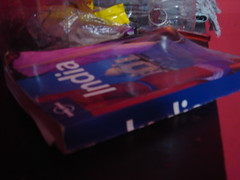
My travel book is such a temporary thing. Above, you can see what is left of my 2008 India Lonely Planet. The other parts of it are finished, checked off, complete, gamarnu, so we don't carry them with us anymore. Surgically removed, and then discarded. Judging by the size of the remaining travel tome, there is about 1/3 of India to go, 2/3 down. Our plan, to finish off India, is to first visit the top of the I, take a train to visit the upper part of the letter d, and then take a long bus down to the dot of the i, where we'll spend the end of our trip, before getting on the plane to go home.

In the future we won't have Lonely Planets. I'm looking forward to the new digital travel tools of the future. What they will be is an interesting thought experiment.

In this installment of our adventure much is done. Done about issues of international importance. We set out to Rajasthan, the Indian state closest to Pakistan, in search of Osama bin Laden. We are American, after all, and have certain duties, responsibilities, and allegiances to consider. But before we set out in this goal, we have some things to do. Things to consider. The border is far off, in any case. There are many things to see on the way, and many places to look.
entering rajasthan

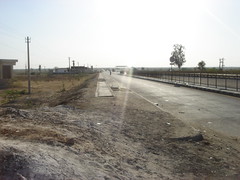
Rajasthan is known for many things, like Rajputs, castles, deserts, camels, colors. We set out for Pushkar, the chill out capital of the former Rajput empire. On the train from Agra we meet a man from Lucknow, who says he loves how the sea comes into the city in San Francisco. I suspect he is a poet, and after we talk some more, it becomes clear that he is an renowned poet from Lucknow.

We stop in Jaipur long enough to consume some awesome dosas, nourishment we have missed since south India, and an illicit beer delivered to us out of a man's pants. We don't ask too many questions in these cases, and simply do as we're told, moving to the back of the restaurant, paying cash up front for the 750ml bottle, and drinking out of glasses wrapped in napkins. The dosas are really really good, some of the best we've had.

Pushkar
pushkar market

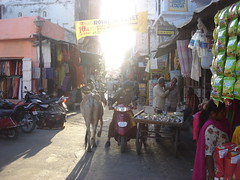
Pushkar is a town of no more than 20,000 people, built around a serene and holy lake, and is the site of India's only Brahmin temple. If you count the Israeli backpackers, the population is maybe 30,000, and if you count the rest of the travelers, then maybe 40,000. I might be exaggerating, but only by a really tiny amount. The place is so popular with Israelis that there has been a Chabad house here for over 8 years, which is completely true, but we'll return to the matter of the Israelis, and the Chabad house in due time. Hebrew appears almost as often as English in the main market, and parts of the main street are lined by Israeli style street food shops, filled with stoned Israeli travelers munching on falafel.

We arrive at night, and have a funny time finding a guest house. We settle on a place filled with really friendly French people. They feel like a big super happy, super laid back family. The feeling is a bit weird, and the owner, who is 20 something, feels like he could have grown up anywhere in the world.

At dinner, everything becomes clear. It's a guest house full of French people who have basically been living in Pushkar for months, pretty much constantly stoned. First thing in the morning, the bong comes out. That's why they are so over the top shanti, and friendly. We share a nice meal with them, the guest house owners, and some other guests, on the roof.

Bhang is a marijuana derivative, and it's vital part of life in Pushkar. Maybe all of northern India.
pushkar

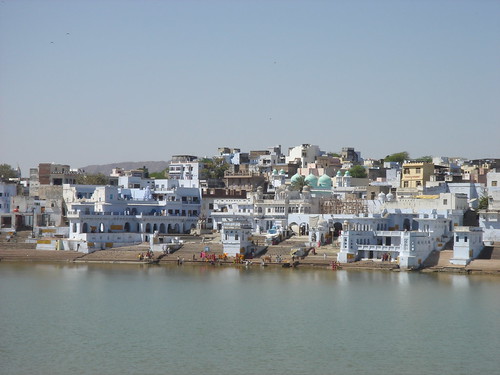
This is a view across the lake. Birds fly around it all day, and it's relaxing to just sit in the gazebo, or a cafe, and read and look at the water. You can see ghats, stairs like we saw in Varanasi, surrounding the lake.
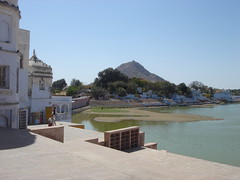
pushkar ghat view

I understand now the step well from Ahmedabad a bit better. It seems like Indians like to interface with water through stairs. So, you line the river with stairs, which we saw in Varanasi, but also in less intense form all over India. Pushkar's holy lake is surrounded by stairs. The step well makes more sense now. A step well allows you to interface with a well through stairs, as well.
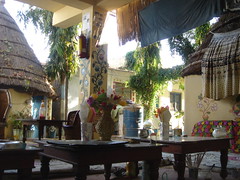
moon cafe

Pushkar is indeed a chill place, and it's understandable why people spend lots of time here. Here is a snap from the Moon Cafe, across the water. Bhang Lassi is the same price as Coconut Lassi, which means that Marijuana is as easy to come by as coconuts.
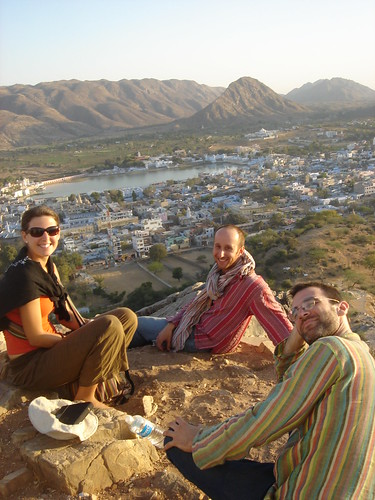
happy pushkar hikers

Here we are, along with a new friend from England, Becky. We've just hiked up to the top of a mountain to watch the sunset. In the background, you can see the town, and the lake.
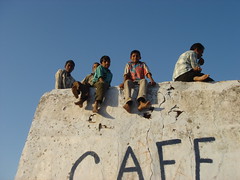
top of hike

We play with some nice kids on the way up. On the way down, they transform into evil vampires.
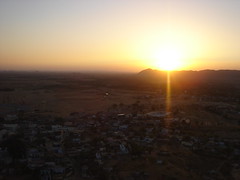
pushkar sunset

Chasing sunsets never gets old.

shiva child

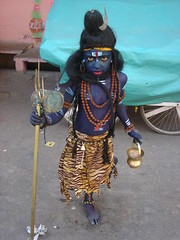
We are in Pushkar for the Shiva festival. Above is a child ready to go trick or treating as Shiva. Hindu theology is still as mysterious to me now as it was two months ago, but I understand that Shiva is the God of intoxication, among other things. Sadhus, a kind of Indian holy man, spend much time naked, and stoned on bhang. Bhang lassi -- lassi with an extra bhang bang -- is served on this day. In Pushkar, however, it doesn't seem to matter whether it's a holiday or not, or even what day of the week it is, if you want bhang.
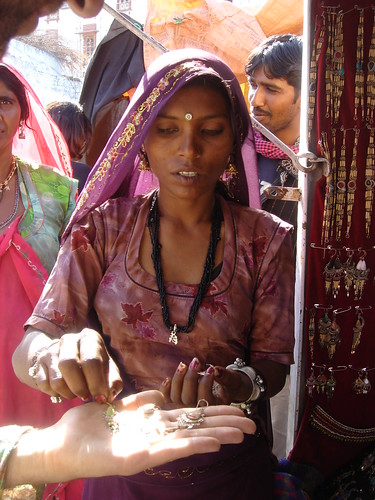
rajasthani lady

In our first guest house dinner par-tey, some local Rajasthani villagers, friends of the resident French travelers, eat with us. Later, we meet the mom, who is striking, at her shop. We know some of her story, how she lives, her family life, and so on, so when we buy from here we don't even bother to bargain.
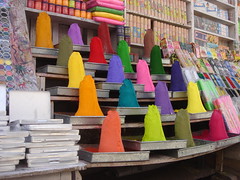
color me colorful

India is a colorful place, and Rajasthan is known as one of the most chromatic. Here are some of the raw materials.
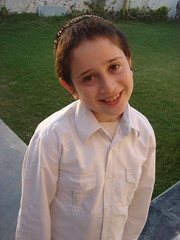
rabbi's son

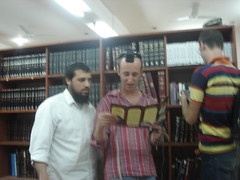
An English lady from our guest house reminds me that Shabbat is coming up, and that Pushkar has a Chabad house. Some background is in order. Shabbat is the Jewish day of rest, and Chabad is a sect of Hasidic Judaism that believes the Messiah will come once all Jews are observant. They are very friendly, lots of fun, and they chase Israeli backpackers and Jews all over the world. You can find Chabad houses in Bangkok, Thailand, all over India, South America, and even Morgantown, West Virginia, where there is a synagogue in my old house's family room. Above is the Rabbi's son.
chabad me

Above, I am putting on Tefillin, which I haven't done since my Bar-Mitzvah, I think. The dinner they serve is delicious, healthy, Israeli style food. From a balcony of a guest house next door, some Indians stealthily look on to the dinner, and all of its ritual and activity, with great interest, reminding me of how I peer into a Hindu temple, wondering what the heck is going on inside.

So why all this Chabad in Pushkar? It's a very popular Israeli travel destination. It even has a Yeshiva, a religious school, and Mikveh, or ritual bath. So why all this our in the middle of the desert? The Chabadniks, in their 19th century Polish outfits, dressed in all black, look a bit out of place in the middle of the desert, where all the Israelis are dressed in loose fitting, sun and heat friendly, white.

Later, I meet some Isrealis with some hints. They explain that in school, when they are growing up, they are warned about going to India and doing too many drugs. A mom's greatest fear is that her child comes home thinking of themselves as an orange, or maybe a dolphin who has to be kept in the bathtub all the time, in order to stay wet. Moms are also afraid their children will return home ultra-religious, which of course makes all the pieces here, the Yeshiva, the outreach, the drugs, fit together a bit better.

The age of the Chabad house, eight years, explains another thing, too. This has been a popular travel destination for at least a decade, so the locals have had plenty of time to adjust. Many of the guest house owners, hip and young, are culturally indistinguishable, in many ways, from the travelers. How they talk, what they smoke, how they behave. Why? Probably because they came of age while hanging out with with the travelers they now host.

Satisfied that Osama is not in Pushkar, we move on. Our trip happens to align with Becky's, so we caravan to Udaipur. Becky is one of the few, brave, individual female travelers we meet in India. Foreigners attract a lot of attention in India, and female travelers even more so, almost all of it unwanted. A typical conversation for us begins with being asked these questions: "Where from?" -- What country are you from?, "How old?", "Married?", "Why not?", name, and so on. Becky is more than happy to claim Alex and I as her two husbands, to simplify things, on the bus trip to Udaipur. This might raise more questions, though, than it answers.


Udaipur

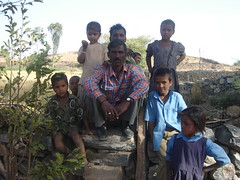
On the way to Udaipur, traffic comes to a dead stop in the middle of nowhere, as a truck is righted back onto the road. We meet some local villagers, as well as other stopped passengers.
rajasthani villagers

I've been in India for two months without really getting sick, aside from a minor cold here and there, some congestion, or some slight digestive discomfort. But what about the Delhi Belly? How lucky can I be really? Oh not so lucky forever, as it turns out. In retrospect, I think it was the delicious snacks I bought for the bus. Becky and I were the biggest fans, and were knocked out for the longest period of time, while Alex didn't like it that much, and was only sick for a day or so. The bag said 500g on it, but it weighed more than that, and was taped shut. We gave it away to a ragamuffin as soon we noticed this, but only after consuming a handful or two of delicious and spicy Rajasthani junk food.

While one can't be sure, I think the snacks were at fault. Nothing the nuclear option, antibiotics, plus some sleep and water can't fix, though. But my experience of Udaipur was kind of weak, since I spent most of it in bed, so if I'm unenthusiastic about it, it's because it isn't that cool, or I wasn't so cool. Maybe both.
udaipur at night

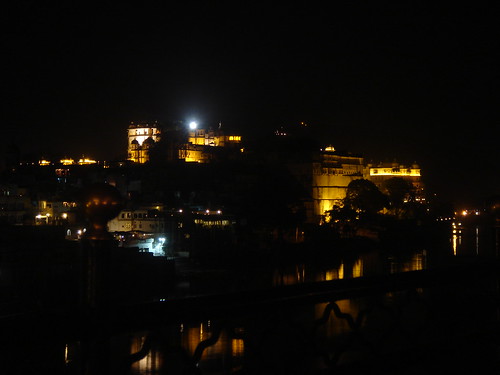
Finally, we arrive at night, to Dream Heaven Home, our guest house of choice. It's important to have a place picked out if you are arriving at night, as searching for a place, at night, with a big backpack, is no fun at all. Above is the view we see, as we sit down to our first real meal since breakfast. A glittering palace and city, resting on the edge of a lake. It's totally magical, and this photo, and my description, can't properly convey the feeling one gets up here at night.
DSC04732

The guest house itself has a really nice design touch, as well. Sitting up here, on the rooftop restaurant, is a real pleasure. One feels like a Raj, or a Mughal king.
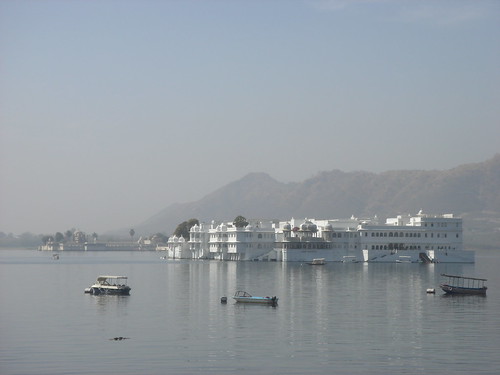
udaipur's lake palace

Udaipur is famous for surrounding some lakes, with a palace built into the center of one of the lakes. The lake palace appears in the Bond film Octopussy, and you can choose from over 100 venues to watch the film every night.

The city palace museum was ok, but the real magic is looking at the city at night from the guesthouse's rooftop restaurant. I don't get the sense that one can fully interface with the lake, and it's beauty, unless it's from a few prescripted places, which is kind of lame. On the other hand, I spent most of my time in bed, so what do I know?
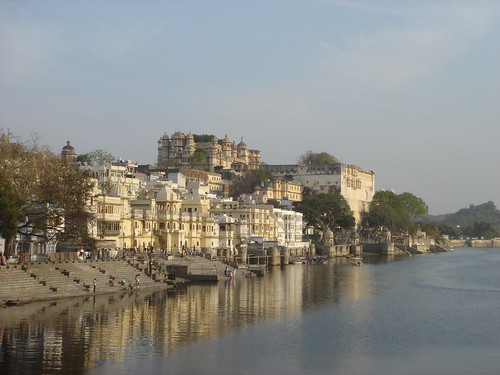
udaipur city palace at day

This is the city palace we saw at night, earlier, during the day. This is not the palace on the lake, but sits on the edge of the lake. It's lovely.
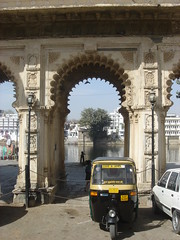
ghat gateway

This is a gateway to a laundry ghat. Women and men also bathe here, in different sections. It's easier to appreciate the importance of water to all life while traveling in India. You don't have running water everywhere, and clay buckets of water are often ferried about, coming from wells, and stored in houses and restaurants. The use and importance of water is less transparent here, and it's integral relationship with our life is made more obvious. Many kitchens we eat at cook with tubs of water that is carried in. We see people do laundry and bathe in public, near real bodies of water, all the time.
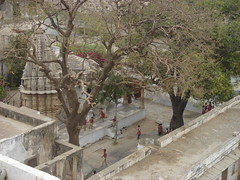
school temple

We are surrounded by all kinds of interesting things. From our room's window we see a temple that is also used as a school for children. We can see and hear them running and shouting, and teachers wandering about.
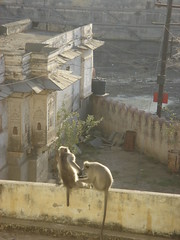
monkey morning

Every morning, below our window, a troop of monkeys does what troops of monkeys do. Monkey business. Sleep, pick bugs off one another, and play and swing from branches.
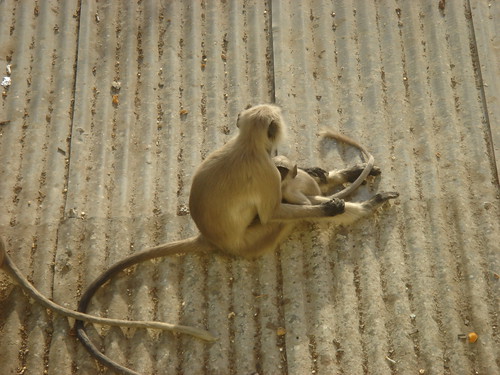
mother and child

Above, a mother and child.

udaipur alley lil raj miss

It turns out the non-touristy area behind our guest house is quite lovely, a snapshot of quiet Indian city life.
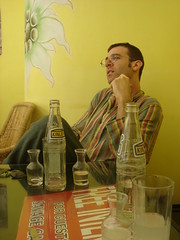
alex in cafe

There's a really cute German bakery type cafe in Udaipur that is popular with travelers as well as locals. Alex and I have a snack, and we meet a nice guy from Kerala doing a PhD in Udaipur in chemistry, and two cute high schoolers -- all of whom seem as international as any visiting foreigner. This is interesting to me, as we meet lots of Indian people from a broad spectrum of walks of life on this trip. These folks could have told me they were non-resident Indians from the US or England, and I wouldn't have known the difference.
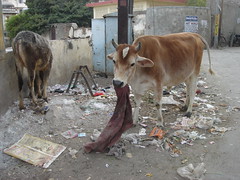
mmmm fabric

In all of India, city cows seem to mostly subsist on the copious amounts of trash that is thrown into the street. These particular cows have a sweet spot staked out on the walk to town from our guest house. This bovine breakfast must be inspired by The Hitchhiker's Guide To the Galaxy -- a towel being a traveler's best friend. In a tight spot, it can be sucked on for nutrition.

Speaking of food -- on the way out we stop for some more south Indian food, as we miss it dearly. We eat at a restaurant that has the world record for the largest dosa -- 27ft in length. It takes engineers, not just cooks, to do something like this. The menu has a 500 Rs 4ft dosa, but we don't go there. What if it ate us?

And so, having escaped with our lives from larger than life dosas, digestive systems intact, we set out towards Pakistan, in search of Osama, with a few more stops in Rajasthan along the way. Stay tuned for accounts of all this and more -- larger than life photographs, and thinner than real written images. And bring your pajama pants, as the riding gets rough. Harem pants and dhotis are acceptable, too.

Wednesday, March 12, 2008

Agra-Agra-Cadabra

We return to Phases Crossed with another edition packed with adventure, romance, and architecture. That's right, this blog comes with a 100% zero fact guarantee. Zero facts! So, please, don't repeat what you read on the internet to your friends. It might not be true. We do guarantee little or no plagiarism, many photographs, and some words. Words describing stuff. Yes.

But before we return to India, we must return to sword swallowers. Yotam recovered a video of Johnny Fox doing his shtick on you tube, the very one I described in our last post. Further evidence that YouTube is one of mankind's greatest achievements. Along with Wikipedia. In case anyone missed Yotam's comment, below is the video:


Back to India. We take 2AC from Varanasi. Due to some scheduling conflicts not involving Outlook, we end up on a train, late, with no food. The train is hours late, and we get about 4 minutes notice to hustle onto the right platform, right train, and right car. All goes ok. A porter with an awesome turban directs us onto a car. But now we're starving, and we're told there's no food service, and all the wallahs with snacks have gone to bed. Regular Hungry Hungry Hippos, that's us. Magically, cold thalis arrive, filled mostly with liquid food, rice, and 2 roti (flat bread). Most food in India is structurally homogeneous, from curries and bread, to the spherical sweets. Some sweets have some structure. Food structuralism is one of my favorite topics, but it isn't a favored topic of this blog, at least not yet. Liquid food and rice is not an issue, generally, unless you don't get any silverware, because then, well, you have nothing to help convey the liquid food to your mouth.

Naturally, we don't get any silverware. Alex and I, however, having mastered the art of eating with our hands, dive into the thali, cleaning up every calorie on the silver platter. Our Japanese neighbor is not so prepared. He sadly, hungrily, and gingerly dips strips of roti into the food, and eats it, careful to get no daal or curry on his hands. Poor guy. It took a bit of reprogramming to get comfortable balling up rice and daal and eating with my own bare hands. But this poor guy? He's Japanese, very clean and polite, and would probably never dream of eating rice with his bare hands. Unless, maybe, it was some sort of nightmare dream. We remember how his female travel buddy at the station daintily cleaned some dust off her beautiful new Indian sandals. Sigh. Japan and India might be the two most different places on the planet, along many dimensions. Later, we make origami cranes together. All is good.

ecochai

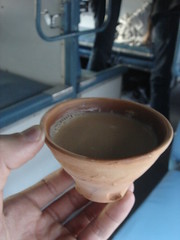
The Chai on trains is good. Sometimes we get things in earthen cups. Eco-friendly, and all! Not fully kiln fired. When finished, it turns back into earth. Cool, no?

The next day, we find ourselves in Agra, the number one tourist site of India, and begin the process of becoming Agrarians. Agra has the reputation as being the most oppressive tourist city in India. Of course, after Varanasi and Khajuraho, we're totally acclimated. I even finish bargaining with a rickshaw driver at one point, and do such a good job, he asks me if I'm Israeli. I am, I guess, but not how he means it -- as one of the hard bargaining Israeli travelers of legend. That's right, we're acquiring Skillz.

We stay in a slightly off the track guest house called the Tourist Rest House, off in nowhere Agra, near nothing in particular, which is fine by us, since we just want a day to relax. Our rickshaw driver is instructed to drop us off at a nearby location, and we don't divulge our final destination, since we've learned our lesson the hard way.

We decide to save Agra for last, doing nothing for first, and some other less famous, but almost as awesome Mughal architecture, for in between.

Nothing. Nothing. Nothing. Ok.

aaaaa

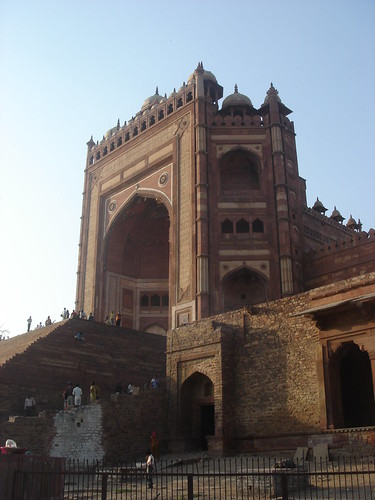
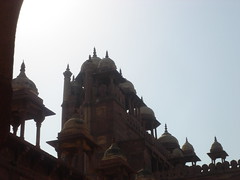
From the folks who brought you the Taj-Mahal, it should come as no surprise that an entire royal palace and city might be constructed outside of Agra city, some hour bus ride away, in what seems to be a desert. Above is the front door for the ruling compound. Fatehpur Sikri is the name of this city -- built, then later abandoned, due to water issues.

dream on

Above, a flock of towers.

courtyard view

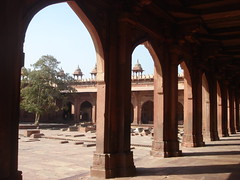
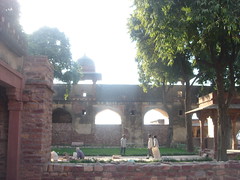
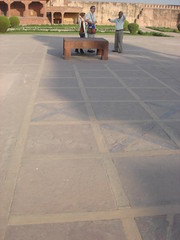
The big entryway opens onto a huge courtyard, too big to photograph. I took a few nibbles at it with my camera.

mosque

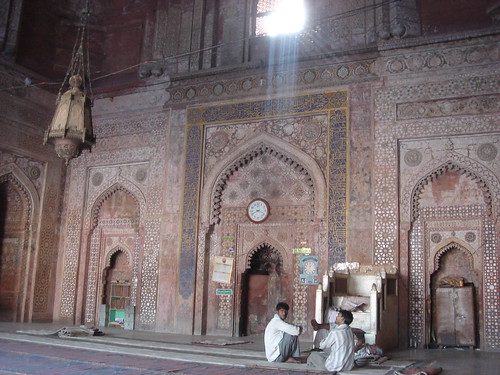
There's a lovely mosque off the side of the central courtyard.

kid

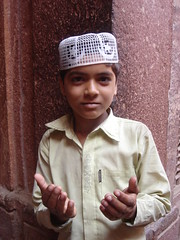
Kids are cute. We hire a guide, who makes up a bunch of stuff that may or may not be true. Alex and I realize we don't like having someone lead our attention around as we wander, visually awestruck, through optically delicious surroundings. Please leave us alone. If we pay you more, will you stop now?

garden

Now, if you're a king you've got to live somewhere. These gardens are near the royal residence. The Mughal (Muslim) king had three wives, a Hindu, Christian, and Muslim. They each had their own quarters.

parcheesi anyone?

Also, if you're a king, you need to play games. Games like Parcheesi, but played life size, with women wearing different colored outfits as the playing pieces. It's good to be the king.

fruit & veg

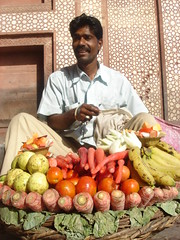
You need enough fruits and vegetables to be healthy. You also need enough servings of photographs of fruits, vegetables, and Indian women dressed in their star burst clothing to keep your blog and flickr stream colorful.

agra fort

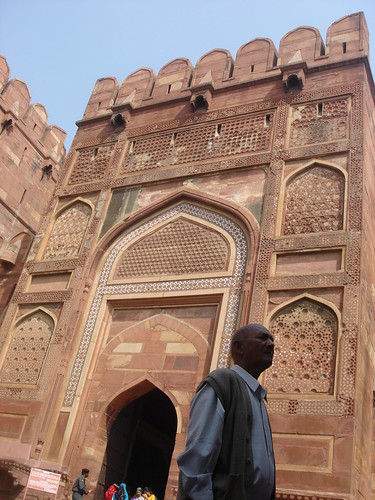
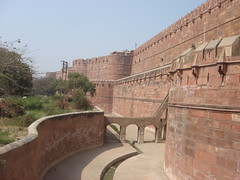
Back in Agra, more Mughal morsels: Agra Fort. It's big and awesome. The Brits used it for many years and leveled many of the structures inside the compound to build barracks. They also took many of the jewels from the Taj, but it's beauty is undiminished, we understand, in absolute terms.

agra fort rampart

Agra fort has a moat that used to be filled with crocodiles. Or tigers. Or something. Something that would eat you, and swim around. The fort, rather than satisfy our boyish yearnings for castles, only stoke them. We must go to Rajasthan, if we are to attempt any kind of satisfaction.

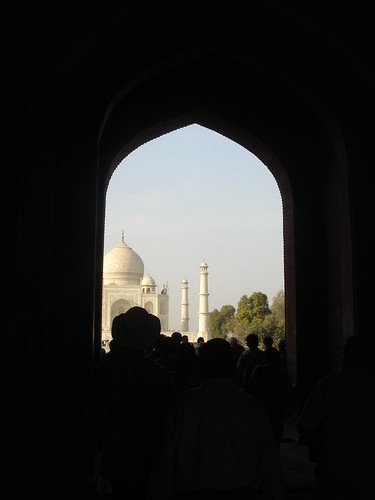
We aspire to great things. Card carrying Taj-Mahalians. Becoming a member of this elite class requires paying lots of money, none of which is used to put up signs explaining their strict, and time consuming, security procedures. Is the Taj Mahal worth it? Yes. I've seen pictures, but it is truly a sight to behold in person.

peekaboo

You step through a portal, and then -- Bam! One of the most beautiful man made things you'll ever see in your life, a thousand tons of marble, lands precisely on your head, crushing you.

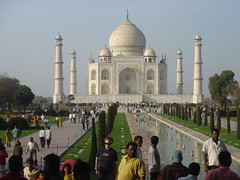
taj

Other people, poets, have described it better than this. Rabindranath Tagore described it as a "one tear-drop...upon the cheek of time." There's an interesting story in the Taj-Mahal, which has many teardrop shapes in it, that makes the sadness here more interesting. The King, Shah Jahan, was so heartbroken when his Queen died, that he built her this beautiful tomb, at great expense. It took 17 years to make, and according to my math, the current price of gold in USD, and some text at the monument -- 213 million dollars. You can check my quick math here, if you like. Afterwards, his son overthrew him, and he had to live out the rest of his life imprisoned at Agra Fort, where he could only look across the city at this monument. He is also buried in the Taj.

DSC04560

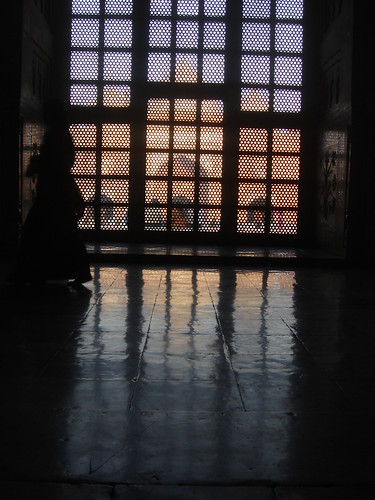
The inside of the Taj is not pictured so often, and it's also very lovely. Above, a peek out a carved screen into one of the adjacent structures that mirrors the Taj.

taj sunset

All this awesome Mughal architecture makes me appreciate something. The kings of Europe, living in their big rock heaps called castles, would seem to be paupers in comparison to the Mughal rulers of India. The level of decoration and luxury they had -- sophisticated carvings, air conditioning, and so on -- puts them light years ahead of European rulers. It also explains why the Europeans wanted to trade with India, and China, of course, so much. They had all the booty. The Paneer Tikka Masala, the jewels, carvings, silks from China, the artisans. India's wealth, to a European King, was the jackpot, the big bam bazoodie.

But actually, this isn't true. This architecture is happening around the time of the Renaissance, so the Europeans are building equally gilded and romantic things. But they still desire the Tikka Masala. Who doesn't, deep down inside?

taj-mahalians

Alex and I have accomplished quite a lot. Having now been to Varanasi, the Taj-Mahal, and Idaho, we can die happy -- having knocked off at least three things on the must-see before you die list. It's time to retire from this itinerant lifestyle. But not so fast. We still have a cell phone in Hindi, and know how to book train and bus tickets, so perhaps we'll go where it's a bit hotter, then a bit colder.

Friday, March 7, 2008

In India, Anything is Possible

In India, people we interact with often tell us "It is possible." Sometimes, "not possible." Other times: "In India, Anything is Possible."

Varanasi is a place of many possibilities. But before we go there, travelogue or otherwise, we must discuss something not serious at all. When I was younger, our folks took my family to Canada, to a Renaissance fair. My mom was always taking us exotic places, and she had always meant to take us to a Renaissance fair. Probably this is why my brother, sister, and I like to travel so much. It's all our mom's fault.

At this fair was an awesome sword swallower named Johnny something. I'm not sure if they had sword swallowers during the Renaissance, but that didn't matter. He was the funniest, most entertaining guy, we had ever seen. Turns out he was a comedian beforehand, so he said, but he took up all these swords and things because people stole his routines. It's harder to steal someone's routine if you've got to swallow a sword. Copping a line is one thing, but shoving a long, sharp object down your gullet -- a bit harder.

After swallowing a bunch of big, sharp swords, he put another one down the hatch, and started convulsing and screaming as if he were dying, and the sword cut open all his insides. The sword, naturally, was flexible. That's the kind of humor we had going on here.

Anyway, this guy had a great interlude in his routine. He explained than the river Ganges, in India, is historically central to life in India, both materially and spiritually. Hindus worship it as if it were a Goddess. Varanasi, which is on the Ganges, is perhaps the holiest site for Hindus in the world. No Hindu's life is complete without bathing in the Ganges once. And he showed the audience this small vessel, and told us it contained water from India, from this most sacred river, the river Ganges. He poured the water out, with an appropriate level of gravitas, until the vessel was empty -- not a drop left. At the next interlude he held up the same vessel, which he hadn't touched, and again showed it to us. "Water from India," he said, pouring it out all over again, "The River Ganges" -- down to the last drop. Stunningly, it had been refilled with water -- pure magic! Every 5 minutes he'd do it again, which was awesome -- where was all this holy water coming from? Water from India, the river Ganges. The mystical power of the river Ganges was forever inscribed in my consciousness.

So. Water from India, the river Ganges -- we're finally here -- Varanasi, the most holy Hindu place in the world. Varanasi also has a lot of history with travelers from the West, as it was a major site for pot smoking hippies to travel to in the 60's and 70's, and absorb lots of eastern religion, expand their minds -- that sort of thing. Why? What's so special? I can show and tell you a little bit.

Varanasi is also the most ruthless city in India, as far as I can tell, for harassing and exploiting tourists. We travelers are but sparks that leap from the ATMs into their pockets. All they must do is perform enough careful stagecraft, yell loud enough, harass us enough, or mislead us -- and all our money will be in their arms. The old city is a maze, and everybody wants to guide you to your guest house, or perhaps their guest house, where your rent will go up to pay for the tout who brought you there. That's how it works. All the signs for food and guest houses are painted on walls, since touts tore the old ones down. Guest houses have similar names to one another, to mislead people. I almost manage to game the guy who meets us on the platform -- the guy you never want to deal with -- we're in his car, having driven 20 feet, price fixed, destination set, shenanigans put aside, when he just stops, and flat out refuses to move. He simply can't leave his original pitch, having failed to game us. Ok, fine. We step out, realizing that our skills still need some more work before we can overturn ninjas on their backs. The next guy takes us, but tries to hand us off to two touts who will lead us to our place. I make the mistake of telling the driver where we're going, and he tells one of the touts. We manage to shake all of them, but one of them actually meets us at the guest house! The Chutzpah! We've learned our lesson. Drop at secure locations, and tell nobody where you're going.

pedal power

We go by pedal powered bicycle rickshaw, from the train station to the old city, to help save the environment. With our bags, it's a bit of a squeeze.

some ghats

Perhaps I should stop complaining. But, truthfully, it is a big hassle and frustration getting around, but the rewards are great. Like, Varanasi is great. This is what I love. The rewards for hard traveling. Magic like this. The ghats, the stairs across India which go down into rivers, go on for about 6km up and down the river in Varanasi.

warez

The old city behind the Ghats is also mega-cool. It's a real bazaar, a twisty, knotted, collection of buildings, tunnels, shops, cows, and all the important elements of urban life. In a really confusing, fun, space. These things can take time to get used to. Like, it takes time to learn how to dodge all the animal poop in the street. And you have to do it at night, while having a conversation, and having your attention drawn by everything in sight, like shops, and passing motorcycles, people, and cows. One night the alley outside of our guest house was spattered by a diarrhetic cow, which was the first time we saw an Indian get frustrated by the poo. Our guest house owner, though, seemed more irritated by the business implications than anything else.

poo patties

In general, poo is useful. Like, people collect it, make cakes, dry it, and then sell it. As fuel. And the cows eat the trash. This is fine, except now India is covered in plastic which cows can't digest so well, even with their many stomachs.

ghat man

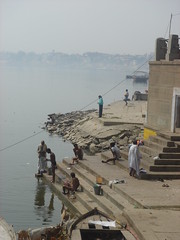
Lots of things happen here. Massages. Two, please. People bathing. Boat rides. Religious rituals and singing, music. Bodies are cremated on the burning ghats, no photography allowed. We meet some interesting folks, Indian and not.

ghats a dip in the ganges

People walk about, and some other people take a dip in the sacred river Ganges.

man alone laundry time

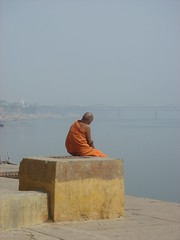
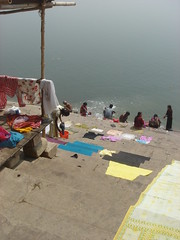
Above, a Buddhist looking monk meditating, and people doing laundry. You might get spiritually clean here, but the river is very very polluted, actually, mostly because of industry.

river ritual varanasi burning flowers

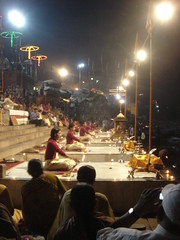
Some of what can go on at night here. Lovely rituals I don't understand, accompanied to really nice music. Some adults try to sell you drugs, not so pushy, while really pushy kids sell you tiny lotus candle things you set alight and put into the water.

varanasi at night

An old city passage at night, photographed thanks to Yotam's awesome Guerillapod, one of the most fab pieces of technology since the camera obscura.

varanasi brown bread bakery

Varanasi, due to its international draw, has quite a lot of backpackers and tourists. We eat at I:bo, an awesome Japanese owned place, and have some really nice Japanese food. I:bo also has the cleanest squat toilet in all of Asia, Japan included. They do nice Thai and Italian food, too. Above, a stylish bakery with excellent cheeses and approximations of Croissants. A really cool vibe, too. We chat with some interesting Indians from Delhi. Lots of buildings here use the traditional architectural style of a central, open, courtyard extruded upwards, which is what you're looking across, above, and where the light is coming from.
brown bread bakery up ganga fugi

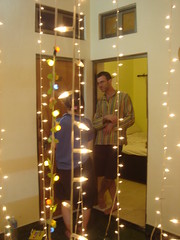
Above, a picture up into the skylight of the bakery, and adjacent, our guest house, Ganga Fuji. Trying to attract Japanese, we think, with the name, and the pictures of Fuji-san when you enter. It seems to work -- Above Alex is talking to a Japanese traveler. Sagoy! It also has the central extruded courtyard, through which they run these colorful lights.

The burning ghats are one of the most striking aspects of Varanasi, where people are cremated. There's simply no explanation, and you must see it yourself.


In Hindu and Buddhist theology, you are reborn over and over again, coming back each life in a way that reflects how you performed in your last life. Perhaps as an animal. Perhaps achieving enlightenment and not coming back. People come here to die, actually, because they believe that if they die here, in Varanasi, they escape from the cycle of life and death. This is a very powerful idea, if one believes in such a cyclic universe. Escape from the cosmic cycle of life and death.

In the end, despite staying right in the hurlyburly center of the bazaar, we've grown comfortable, and could stay on another day. Perhaps became hippies and move here for a year, go up to Nepal, hang out. But we've got tickets to Agra, and it's time to move forward.

Monday, March 3, 2008

Khajuranimo!

We must revisit the packed population habits of our travel one more time. If you are tired of seeing and hearing about it -- well, you can imagine that it must be far more entertaining to actually do this, because we continue to do it.

rise and shine

After stopping in cities with names like Nagpur, we make our way to Khajuraho, whose claim to fame you will discover shortly. It is a very small village, but with its own airport, so it must have something goin' on...

train with a view

Above and below, pictures from another II class train trip. We don't do this because it's our first choice. We have no choice, really. Trains fill up crazy fast. Elbowing your way to the front of a "line", though it's really more of a heap, is a little bit of a metaphor of how I feel about booking these tickets. No, you can't just walk into a train office and book a train you want to get on. As if. There are lots of people trying to get places, and only so many spots. If a fixed number of spots isn't a concern, then go ahead, unreserved second sitting is what you've been waiting for. Besides, you get to see some interesting things, and meet some nice folks.

selling food

People bring you lots of food. We're very careful about what we eat.

II from above

This time around, Alex and I hold onto the choicer top spots. Since one must be willing to clamber around to get up here, it's less packed. And these are finally some photos, I feel, that capture the intimacy, joy, and fully embodied nature of this form of travel. Kids love to stare at us, but shyly, when they think we aren't looking. We're so weird looking, after all. I like to make faces and play with them.

busy busy train station

So what is this Khajuraho we're after? It is no less than a cocktail of rocks, art, religion, and sex. What more could one want from a travel destination?

We stay at the Osho Zen guest house, perhaps an appropriate choice for this travel destination. Finally -- a guest house designed for backpackers, with something of a courtyard to meet and chat with other travelers, and swap stories and information. No more budget accommodation for Indian business travelers, or wherever we've been staying. These people speak our language! They serve pancakes and cornflakes for breakfast. I've gotten the hang of Indian sweets in the past few years, but Indian breakfast food, aside from Idli, Masala Dosa, and other nice south Indian fare, totally elude me. Westerners like bland food for breakfast. Mmm cornflakes, toast, pancakes, and sugar.

a temple complex

About 12 temples are in the main area, which costs 250 Rs to get into. It's a lot, but whatever. Indian nationals pay a fraction of this. Everyone working there finds it really funny that our ticket is only single entry, so for a day's visit it's 500 Rs. Ha ha.

wipe cut

This is one of the most aggressive towns we've been in, speaking of touts, begging kids, and so on. Speaking of getting screwed, below we have some fine sculpture, for which this place is so well known:

doing it

The breakdown of material here is interesting. In the interest of our broad audience, we will try to keep to a strict PG-13 rating. Or maybe that's R. I don't know. In any case, above, a rather tame sexual act depicted in stone. Things get much raunchier, with multiple people, and sometimes animals. If you dive into the flickr stream, perhaps zoom in on certain pictures, you will find all kinds of highly creative erotic material.

tuchas alex rosmarin's kajuraho lass

About 50% of the carvings are just plain sexy, as seen above, alongside Alex Rosmarin's interpretation of the finely carved ladies of Khajuraho.

stuff happening

The rest of the carvings are just nice carvings depicting all aspects of life, as far as we can tell. But that doesn't get you fame, does it?

moi

Here is one of our many heroes, posing beside a fine piece of rock.

boar happy ganesh

But these are old Hindu temples, after all, though none of the ones we visit are functioning. Above, a really nice carving of a pig. A source reveals to us that the many deities on the pig map to the fact that there are as many Gods, in Hindu theology, as hairs on a pig. Pigs represent money, and Lakshmi, the Goddess of money, guides this pig, though only her feet remain in this statue. We love pigs. And beside this boar, a Ganesh carving. Ganesh is very popular.

goat

Did someone say animals? India is most well known for cows, but dogs, goats, and water buffalo appear in equal numbers. Below, some super cute water buffalo.

moo?

All these animals, whether they be dogs, buffalo, goats, or cows, are often pregnant, and babies abound. At home, we perceive animals differently, and aren't exposed to the full range of life in such a direct way as we are here, in India. And I mean this in the broadest sense, not just as we see depicted in rock here.

german tibetan bakery

Above, one of the joys of being back on the backpacker circuit. A "German Bakery" run by a Nepalese man. Later we buy some cookies from his son. Nepalese are all over India, often in the most backpacker heavy areas. They are often masters of international cuisine, as well as, in general, being super sweet, and super hard working folk. I heart them.

alex on a tight bus

Above, Alex on an outward journey from Khajuraho. Where are we going next? Varanasi.

Saturday, March 1, 2008

Movie Moghuls

What, exactly, is a Moghul? Read on, and you certainly won't find the answer, but you might find some nice pictures of their architecture. We like Babur, but not just because he is a children's book character. Read more, and find out a little bit more, but not too much more.

Some readers have been carefully researching, mapping, and digesting our titles. Perhaps we have erred. Perhaps they have. Nobody knows. We apologize to any of you with broken hearts out there. We'll find a tiger. Somewhere. Maybe. Alex is a good artist. Maybe he can draw one. Maybe we can find a picture on the internet. So many possibilities. Perhaps we can find one in India. Maybe.

Those keeping close tabs on our progress will remember us attempting to reach the northern parts of India, from the southern ones, via an unconventional, for tourists, series of stops and modalities through central India. A Passage Through India. No direct rail route -- which makes me remember reading, that Walt Whitman wrote his poem after learning that the trans-continental railroad in the United States had been successfully linked up in Utah. He was a clerk in a government office. Our travelogue continues where we stopped last, Madurai -- going exactly where other travel writers don't dare to tickle, tread, or type.

unreserved second sitting

We ride unreserved 2nd sitting, because we're hard core. This basically means that Indian Railways issue as many tickets as they have paper for, and put as many people on train cars as can fit, which turns out to be a lot more than you'd expect. Above, but a mild taste of what happens. People are sitting above these people -- you can see their legs. Above -- that's where luggage and more people go. We sit up there next time. It's more comfortable, in a way. People sit on the floor in the aisles, and in between the bathroom doors, at times. It's a great place to really meet people, in these conditions. People aren't used to seeing foreigners, and you spend a lot of time under intimate circumstances with a lot of strangers. We learn much about one another.

I love climbing around the train. As you step over between, around, and through people to get down the aisles, you can grab onto all kinds of surfaces to manuever around. It can take quite a while to make it through a train car. All my climbing skills are exercised here. Nice.

Pondicherry

First stop is Pondi. It's on the coast, a former French colony, and is interesting. It's like India*.8 + France*.2.

mother & sri aurobindo

Auroville, which is nearby, but remains untainted by our traveller's feet, is populated by Aurovillians. It's most remarkable achievement, perhaps, is that it hasn't collapsed. This is remarkable as it is a 60's era new age commune, and most of those have collapsed.

We stay in the Sri Aurobindo Ashram's guest house, entitled the Park Guest House. It's on the seafront, and we get a double for like 250 Rs. At night we can hear the ocean in our room. Sri Aurobindo's partner, an unusual state of affairs for an Indian holy man, was called Mother, and she set up this utopian Auroville community. It's slightly inappropriate, but I am reminded of Walt Disney's original vision of Epcot as a utopian community, perhaps more in the Bucky Fuller sense than in the spiritual sense, though.

park guest house garden

An interesting thing about this guest house. No drugs, alcohol, smoking, and a 10pm curfew. As in, they lock the front gate. It's right on the beach, and very peaceful. It's very simple. The rooms are just two beds, mosquito nets, and a bathroom. But, it's also the cleanest, and most pleasant place we've stayed. Masala Dosa is available in the sea-side cafeteria room, with tons of sunlight, and there's a lovely garden. An institutional architecture with lots of love, like some Kibbutzes. It makes me think about all the places we stay that have televisions, AC, and a host of other features that are luxurious, but unecessary. But, those places often fail at the fundamentals that this guest house takes care of so well -- like clean sheets. You can be bitten at night by mosquitos, but you have a tv, in other guest houses. I find this rather obvious observation slightly profound. Take care of the necessities really well, and that's all that really matters.

le jardin

The town, Pondi, is quite interesting. Above, a picture from a French park. At the center of the park, a totally out of place greco-roman looking thing surrounded by cannons facing outwards. This, then, is surrounded by bits of Hindu temple looking sculpture. It's the French defending this kernel of Europe with cannons, facing India from inside out. But they are gone now. Kind of.

Their architecture remains, which is very interesting. Every morning and evening, many people walk up and down the giant sea-front promenade. It's interesting to see how people react to and use this architectural context. No Indian city we've see has this kind of architecture, yet everybody knows what to do with this architecture, since walking up and down it just feels right. Very Christopher Alexander.

Many French tourists are here. Many expensive (for India) restaurants are here with very good food.

rick love

Above: a curvaceous anatomical detail of one of our escape vehicles, a rick (auto rickshaw). Choo Choo. Next stop, by awesome long distance bus: Bangalore.

Bangalore

The Lonely Planet says that if you find yourself in Bangalore, it isn't a total dead loss. This is true. Bangalore and Hyderabad, which we'll visit next, are the hubs of the new Indian information economy. Most of the software and high tech work in India is done here.

One of the nice things about coming to a town like this, is that nobody expects you. There are no cute guest houses, and an army of touts trying to separate you from your money by every conceivable manipulation. No. The foreigners here are mosty from developed countries, and working here, taking part in this brave new IT world.

japan food

This means food. We sit down to an Japanese meal. The food: exquisite. It's only appropriate that Naomi took me to one of the best Indian means I've had in my life in Shibuya, Tokyo, and I've had one of my best Japanese meals in Bangalore. The restaurant, once we're inside, could be anywhere in the world. The Indian staff are as polite as any staff in a Japanese restaruant. Japanese salary-men smoke and eat, Japanese news is on tv, Manga abounds. So good.

kinda busy bazaar

Our room, with balcony, affords some nice views of the bazaar buzzing outside. It's kind of seedy at night, but this is all strength training, and enjoyable in its own right.

use me

There's a nice British colonial-era park in the city. We walk around there. Pictured above, a creatively designed trash can, asking park visitors to take advantage of it.

We hop on another overnight bus. Woohoo. The bus station in Bangalore is a force to be reckoned with. It is the biggest and busiest bus station I've ever seen in my life. Imagine walking through a life sized maze of huge moving walls, that just happen to be buses. Somehow, we find our bus, and get on.

Hyderabad

hands on banana leaf thali

Hyderabad is like Bangalore, but with more fun tourist stuff to do. Like eating with your hands. Actually, you can do that anywhere in India, but this is the first time we get a real banana leaf Thali, and it's about time, since we're on the verge of leaving South India. You don't just smell, taste, and chew the food -- you enjoy its texture with your hands. The ribbed banana leaf feels nice, too. A tactile experience. What would Brillat-Savarin think? This should only be done by trained professionals, or amateurs, such as ourselves, who have thoroughly washed and hand sanitized before hand. The food here: Awesome. We return many times.
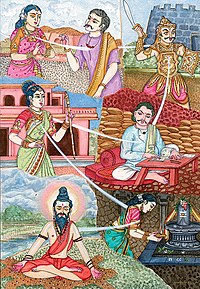
Thalis are fun. They bring you a set meal, different depending on the restaurant and the cook's fancy, and most items are infinitely refilled as you consume them.

fundustan

One can't really know a country until you see it through the lens of its amusement parks. I think. Yotam and I found this out when we visited Singapore's Sentosa Island ("Island Life, Dig It!" -- though Singapore already is an Island...). Now Alex and I go to Ramoji Film City. This is motly skippable, especially because it takes a whole day.

mouth of fundustan indian film set

It is really fun, though, to see Indian movie sets of anonymous dusty Indian urban areas. We'd already abstracted them into a kind of single modern urban architecture, and it seems they have done the same. The locals, naturally, find matching sets to familiar movies far more interesting than we do...


Far more interesting in Hyderabad is the Salar Jung Museum. Just the family's artifacts, their couches, and so on, are fun enough. It's a little like a Wes Andersen movie, but in museum form. A strange, wealthy, and prodigious family's intimate and absurd material details. The crazy art from around the world they collected is truly cool, too. Above, a picture of some Indian Miniature Painting, of which they have a great collection.

hyderabad's mughal tower chaim and alex in da tower

On our way out of Hyderabad, we do a crash tour of some of its architectural highlights. Above, this crazy Mughal tower, and a photograph, next to it, proving that owning a fancy camera does not correlate with knowing how to take pictures.

crazy crazier taxi

Above, the view from the tower, into some crazy autorickshaw traffic. These cars are not parked. Like a thousand crazed windup toys, they drive everywhere, anyhow they can. Everyone, tourists and old ladies alike, must regularly cross traffic like this on foot, without the aid of traffic cops or crosswalks. If you hesitate, you either miss your opening, or die. One must act decisively. I used to think my life would end, in my old age, either going up or down stairs, which I've always found trickier than necessary, or crossing the street, since I tend to daydream. If I survive Indian pedestrian life, then I think I can make it through any other traffic, so no problem there, and rock climbing has eliminated stairs as a substantial threat to my existence, so we'll have to look more closely at other threats. Maybe ninjas in shadows.

These sights turn out to be more spectacular than a crash tour can appreciate. Ok. This is where the Moghuls from the title comes in, since it is Moghul -- Islamic Indian -- architecture. (The Movie reference is to Ramoji film city. Ok, no more dangling pointers).

pompompomegranete

Fruits are an important part of our diet here. Above, an exceptional addition. For under one dollar the owner of this cart uses a highly developed form of Pomegranate-Fu to open, and de-internal-skin-ify, a Pomegranate. As a souveneir, you even get to keep the fruit, which is very delicious. Fortifying our diet with fruits, such as bananas and oranges, is essential. We are healthier, and digestion is better. I have yet to ascertain the correct price for oranges, since the spread of prices I've paid and bargained for has been quite wide. Bananas are 2 Rupees a piece, or less, in general, which feels correct. Oranges are often 30 Rs per kilo, which feels a bit expensive, since that's the price of a lunch. Once, we got a bunch of bananas and oranges for 32 Rs. One of the keys to proper bargaining is knowing the real value of a good, using healthy portions of experience and The Force, but I am still in a fog about oranges.

birds near the mosque

Nearby is a huge mosque, a big and peaceful space. Mosques are really relaxing after the chromatic riot of Hindu temples, since there is no representation, just geometric patterns, and the spaces are so simple. Large open courtyards, and shallow reflecting pools.

chowmandri

Above, Chowmahalla palace. It is something. Something like a really beautiful palace. You can catch a glimpse of a local fellow whom we became friends with after it became evident that he would follow us everywhere we went, invited or not. He was also on vacation, it turns out, and was probably both curious and lonely. That's the kind of guys we are, I guess.

chowmahalla fountain

Above, a picture of the cenral courtyard. At Chowmahalla Palace, even the guards, admission, and cleaning is super refined. If you put a toe on the lawn, the guards blow their whistles at you, making it feel a bit like a stealth game. Luckily we weren't kicked out, but we don't know what happens if you get whistled at out more than once. Unlike anywhere else we've been, when you pay for your camera ticket, they put a little ticket on a string around your camera. So they are actually serious about this business.

chowmahalla inside

Above, inside the palace. This is clearly where the sultan, or whomever owned this pad, held court. I'm not sure, actually, since we rushed through -- late for our bus.

Our next destination, though not stop, is Khajuraho, which will put us back on the backpacker circuit, so we can expect our travel to be a bit more convenient, and conventional, with cookies, milk, plus all the associated harassment of travelling in the more touristic parts of India.