Tuesday, January 29, 2008

Hampi! Hampi! Hampi!

Now the ramblings of this Berkeley prophet all make sense to me. After the recent tremblings in global markets I, too, searched for safer places to store my dollars. Hampi, naturally, is a logical place for us to invest in. The sunsets, rice fields, ancient temples, and fresh air are excellent places for us to spend our quickly devaluing US currency.

hampi bazaar

Below, we find one of many kiosks in the many bazaar. This one is painted an eye catching blue hue. The daughter of the operator is opening the door to join her mum.
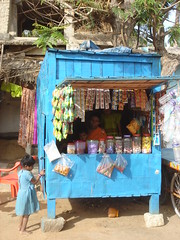
kolorful kiosk

I stay on the other side of the river, which we must reach via motorboat. The older boats, bamboo baskets covered with rice sacks and tar, are no longer in use at this crossing. To cross is 10 Rs each way. At 6pm, the boat magically turns into a pumpkin, leaving princesses and unlucky backpackers both in the lurch. Multiple motorbikes are frequent companions in the smaller, older, boats. Below is our hero, bravely crossing the river by motorized boat.
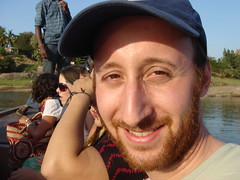
crossing the river

Hampi is much more quiet and clean than Ahmedadbad. India's formidable population must live primarily in the cities, like people in most contries do. The countryside, then, is quite peaceful.
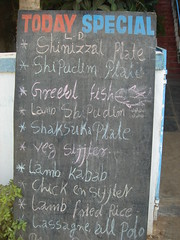
hot on the trail

Here is the initial evidence that we are hot on the trail of the international, but Israeli dominated, backpacker circuit. One can have excellent falafal, schnitzel, Italian, English, and Korean food here. Jachnun, a Yemenite dish, which readers of our blog will remember us eating in Israel, can be found on Shabbat at our guest house restaurant, along with couscous.
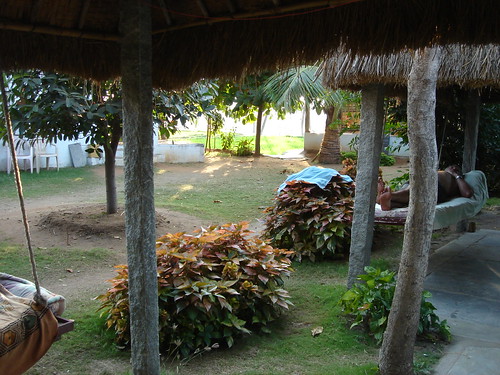
view from porch

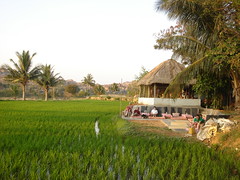
Above, the view from my bungalow's porch. Below, the guest house restaurant, which is run by some really sweet Nepalese folks.
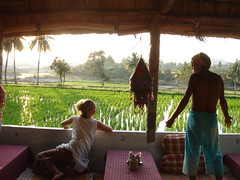
out of the restaurant

restaurant

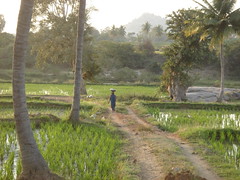
At no added cost, we get some lovely sunsets and lazy mornings with all manner of birds playing around. Below, someone returning home from working in the rice fields.
rice field before sunset

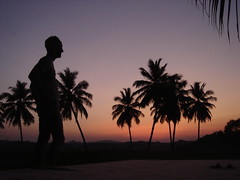
Every evening, we are treated to something like this:
sunset silhouette

Click through for more pictures. I believe that every evening at least 100 photos are taken of this sunset, meaning about 200mb of sunsets per day, times a 90 day tourist season, is, approximately, 2 gigabytes of photos of these palm trees and sunsets in Hampi every year.

hot water

Eager to shower after my long trip, I turn on the hot water and find there is none. I inquire at the front desk, and this steaming bucket shows up. Ok. With the use of a little plastic bucket, whose shape mirrors the large buckets women balance on their heads to transport water home from pumps and wells, I have a hot shower. It isn't as bad as initially expected, and is actually quite nice. One might be cleaner this way, as one focuses first on cleaning, and second on the physical pleasure of hot water. Also, it's nice to be in intimate contact with the physical and material sources and inputs of our lives. Hot water is a luxury for many people on this planet, and it's actual cost and amount consumed is more evident here. The first half of the bucket is for cleaning -- the rest is pure luxury.
cross-century bazaar

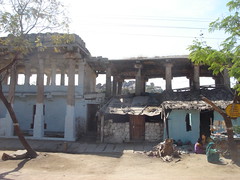
One question this man had about Jerusalem is answered, in part, here. Why would people build on top of one another across thousands of years? I mean, really? A look at this piece of documentation, captured on the main drag of the ancient Hampi bazaar, explains a few things. One can see here some contemporary inhabitants of Hampi freely using the architectural remnants of the ancient stone bazaar. This, of course, makes perfect sense. Why build from scratch, when you can just, say, add a roof, and have a home? It's not How Buildings Learn, but How Cities Learn.
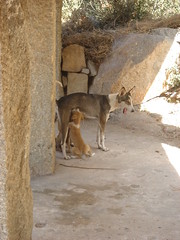
pups

On our first outing into the awesome landscape which surrounds Hampi, filled with boulders and 500 year old temples, we encounter this happy family living in a temple. The mom has just returned home with food for her children. Evidence of having read too much Osamu Tezuka manifested, as an entire story instantly sprang to mind. Young puppies, living on the outskirts of town in the shadow of ancient temples, on a mountain top, wait for their mother to return home with milk. Every day they eagerly await her return, and she seeks out the best scraps of foods to convert into healthy milk. Dal for protein, carrots for vision, and milk for strong bones -- she wants her pups to grow up to be strong. Her husband, their dad, died while defending the temple from an aggressive band of exploitive humans and monkeys. She fights criminals in the town, and is, tragically, killed one day. The eldest pup, who witnessed his mom's death, must come to terms with life here, care for his siblings, defend the temples, and continue fighting the evil that invades this holy place.
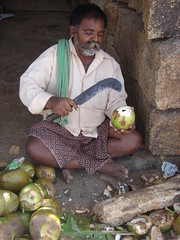
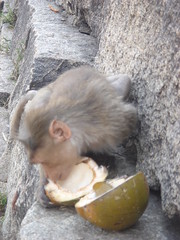
coconut me yum

I like coconuts. So do monkeys. And I love monkeys.
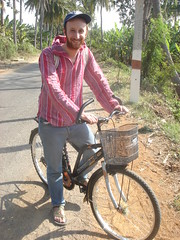
i heart bike

Bikes make me happy. Here is our happy hero, riding a bike, clad in his new shirt. The shirt is a 3 for 1: it protects me from sun, helps the air circulate undernearth my clothing, and adds more color to our modest blog's photographs. Above, I am depicted biking around to various temples in the surrounding rural landscape, which is filled with banana tree & rice plantations, temples, and pilgrims. Lots of Hindus travel to these temples. I visited one mosque, which was beautiful, and found myself totally alone.
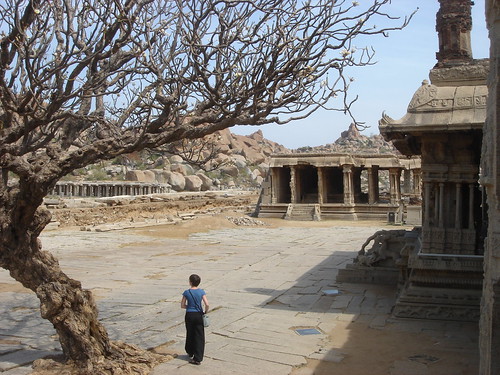
tree

This picture illustrates a typical Hindu temple, and gives a sense of what the surrounding landscape looks like. I find the endless hills with boulders on them geologically inexplicable. Well, I have some theories, but they aren't worth sharing.
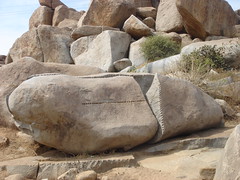
cut cut 2

Many boulders have these markings on them, both on hills, and in structures. Evidence, I think, of how they were cut.
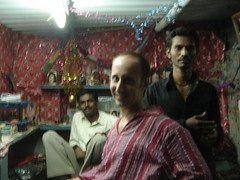
razor ok

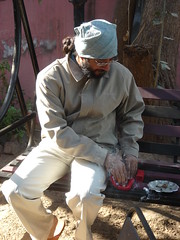
We seek out medical tourism. Here is our protagonist, after having undergone a procedure whereby a large red growth was removed from the facial and cranial parts of his body. The operation, as one can clearly see, was a success. The barber, at right, is 21 or so, and has been working as a barber since the age of 7. The other man let me interrupt his treatment, which can take 30 minutes or more, on account of the meticulous nature of hair removal, massaging, oiling, and so on, so that we could talk. He is a local business man, aged 28, and unmarried -- a bit late for an Indian. But, in a joint Hindu household, the family arranges the marriage, and since it means bringing in a wife and kids, the entire economic circumstances must be considered. Arranged marriages make more sense in this context. A tech worker from Google in Hydrabad informs me, however, that this type of family structure is out of date in most parts of India.
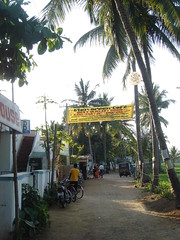
the scene across the river

The main Hampi area, and even across the river where I stay, is a bit of a scene. It is filled with backpackers from all over the world, and small children asking for money, candy, and pens. We are hounded by locals for services and goods at every moment.
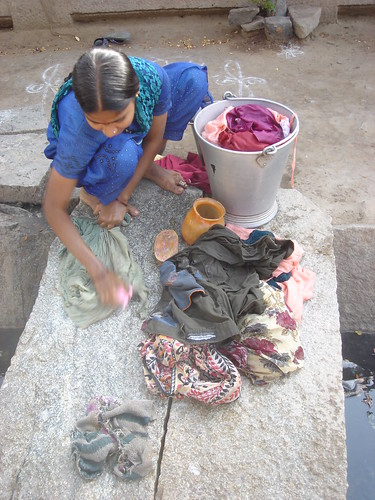
laundry

This woman is demonstrating how most people here do their laundry. In the main bazaar, long canals run alongside both sides of the road, directly below the stone arcade. The stone this woman is working on crosses the canal.

ooh photo

Here we are, then, at a more remote village, Anegundi, that is a bit more calm, and free of commercialism. The villagers here are taking part in a common ritual, where we take photos, they examine the digital replay, get excited, and ask for more pictures. This can go on for 10 minutes, easily, and is quite fun. Initially, I photographed them filling up bags of rice for market.

Some small children in Hampi have learned to ask you to take their picture, and then ask for money, chocolate, or other goods. One must be wary of cute 8 year olds asking you to take their picture. Above, Cynthia of Florida, shows a picture to some village ladies.
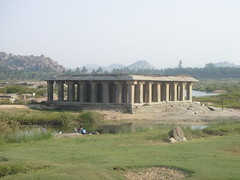
64 gamblers

Here is a temple of 64 columns. At the center we have a group of men playing with cards and money. I tried to capture the very cool scene for readers of this blog, but was discouraged from doing so. "Illegal activities," someone waved me away. Readers are encouraged to use their imaginations. Pretty neat, how the columns obscure vision into the temple's center, no?
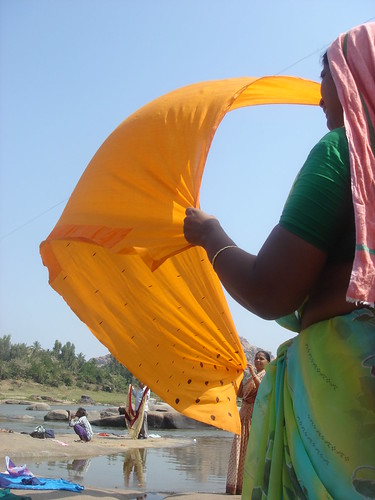
drying laundry

Down in the river, people bathe, and do their laundry. Here, two women dry something colorful.
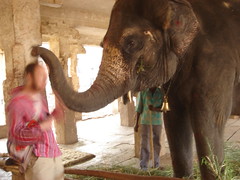
lakshmi bracha

Above we have a most remarkable phemomena. While my physical form might appear, as some would say, blurry, my spiritual form is in fact crystal clear. My physical form visibly vibrates with the emanations from my inner being. I have just received a blessing, or bracha, as the Israelis behind me said, from Lakshmi, the temple elephant. She is, at 20, very young. She likes to eat bananas. To receive a blessing, one must hand her some money, which she grabs with the tip of her trunk. After giving the money to her handler, she delivers a blessing, in the form of a tap, to your head. Highly recommended to all travellers, aged 9 to 90.
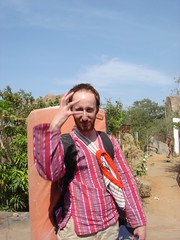
boulder man

Hampi is well known for its bouldering. Here we are, about to undertake an expedition into the hills of Hampi, a crash pad on our shoulders, and gear in hands. Our team of forensic experts are still hard at work, trying to determine the meaning of this body language. Beggum is a nice lady who has a small house at the end of a lane, and serves some of the most delicious food ever, along with renting out used climbing gear. Some might call the shoes abandoned, as they are in disrepair, and what isn't terribly distressed, certainly won't fit well. Climbers are advised to their own shoes. Duh. I trekked around the hills and met some really sweet climbers, and realized I was seriously out-classed here, in terms of difficulty, shoe quality, and experience climbing outdoors. Luckily, crash pads also make excellent portable couches. Dan, a doctor from England, who also happened to be a sports medicine expert and climber, looked at a climbing injury I sustained in Berkeley, and gave me some exercises to do. Thanks Dan the Doctor!

Readers of this blog find themselves in powerful company. Our readership is rather remarkable, in that great world figures are following our journey, step by step. In Jerusalem, George Bush follows hot on our heels, and in Ahmedabad, the Dali Lama isn't far behind. In Hampi, all the tourists are booted for several days so the Indian President can visit the temples. We are bewildered, and wonder what figure will follow in our footsteps, next. Perhaps we will share a Kerala boat cruise with Putin? That would be interesting, Da?

Stay tuned, as we now make our way back to Goa, in order to meet Alex and Yotam, for what is sure to be a great romp with yet to be announced leaders of world politics, spirituality, and commerce.

Sunday, January 20, 2008

Ahmedabad Limited, last stop

Time has crossed, phase shifted, and done other strange things. I write to you now, through the usage of advanced computer technology, as if I am in the past, when in fact, I have advanced far into the Future. It is no small thing. We are in Hampi now, which will be discussed later, when the Time is right, but for now, we write in a voice, and read it back, as if we are still in the city of Ahmedabad, where millions of people are going about their daily lives, and I intervene, ever so slightly, in the name of Science and Adventure.

After the Calico tour, which readers with excellent memories will remember from last issue, I set off on a brave walking tour through the old part of Ahmedabad. With the aid of a map whose creative author freely intermixed historic and modern roads, without bothering to distinguish between the two, your plucky tourist made it 80% through the tour.

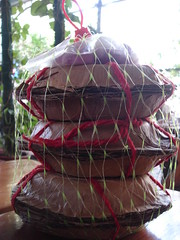
eco-packaging

At lunch, two nice ladies from Mumbai invite me to sit with them, since I am eating alone. They are both interior designers, and the daughter studied at RISD, so we have a bunch of things to talk about. Above, is what appears to be some eco-friendly packaging made from leaves.

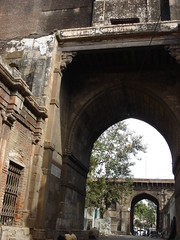
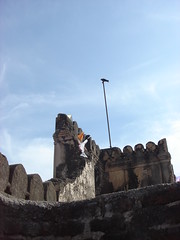
A man with a key unlocks a pasage up to the roof of the city's old fortification. I climb up.

fort base ahmedabad fort

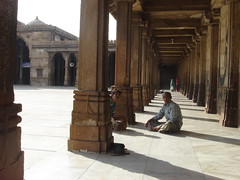
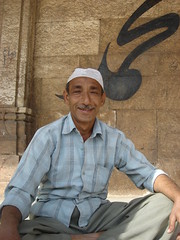
This was a major Muslim city at one point, ruled by Ahmed. Here is a peaceful moment in a Mosque.

mosque man in mosque

At a certain point, fatigued and lost, I find my way back to Ghandi Rd., where the services of an auto rickshaw are obtained.

ahmedabad from above

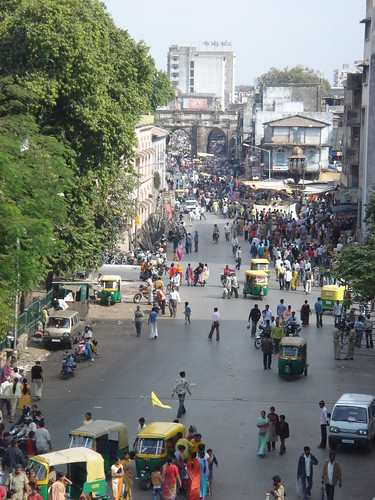
Traffic here is an awesome thing. Pedestrians, cars, motorcycles, cows, bicycles, auto rickshaws, and push carts, among other objects, freely intermingle, navigating around one another. While traffic circles, stop signs, divided roads, and, at times, lane markings, are evident they are, at best, merely suggestions for drivers.

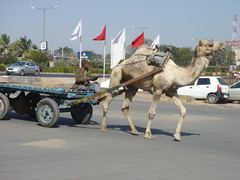
camel cart

It is through a deafening cacophony of horns, nerves of steel, the patience of saints, and the creative resourcefulness of a Cosmonaut that this fluid flow of traffic works. Crossing the street can be a bit of an operation, and decades of video game playing experience are the best preparation possible. Crossing the street is a bit like playing Frogger on Ikaruga's final level.

meal time

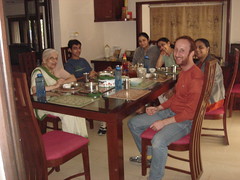
Here we are at Shalin's house, enjoying one another's company after a meal. A little more info on the family structure here, which I find really interesting. The children continue to live with their parents, even after they get married, but the daughter moves into her husband's house. Everyone, not just children, show a lot of respect for their elders. Part of the reason this works so well, I think, is that the parents are modeling behavior for their children; the children watch, everyday, their parents interact with their grandparents. Grandparents can give attention to grand-children every day. By pooling resources together everything is more economical. Life here seems far more social and family oriented than in the US. The nuclear family structure I grew up in is very different from this Hindu joint family structure.

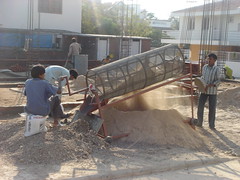
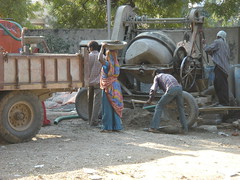
Here are some construction workers building in the neighborhood.

sifting

This is a clever machine for separating rocks from sand.

concretizing

Notice how the women carry on their heads. The cylindrical head-bowl adapter is really clever. The cylinders' ends are circular, and circles can be interfaced to (placed on the surface of) spheres very easily, such as the spherical section of a head or bowl.

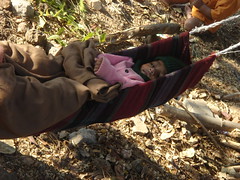
hammock

The kids are hanging out, too, and here is a baby, one of two, in a really clever hammock that seems to have swaddling side effects.

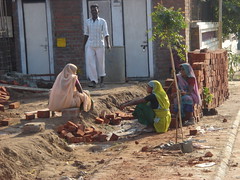
colorful work

Aren't these the most colorful work clothes of any construction worker in the world?

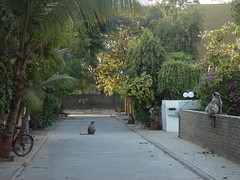
Lots of interesting animals live in this residential neighborhood, most of which are absolutely not the hallucinatory side effects of massive Chai consumption. Here are some monkeys. They are almost as big as people, and can get really loud and rambunctious.

neighborhood primates

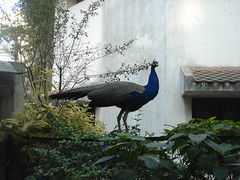
Also, I've never heard or seen such a variety of lovely birds in my life, from big hawks and eagles to parrots and preciously small colorful birds. I am, unfortunately, not suitably equipped to visually report on these matters. There are wild peacocks, too, but they don't jump on and damage the roofs of cars like some other prehensile critters might, at times, enjoy doing.

peacock

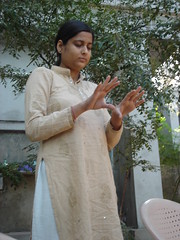
Shalin's mother, Smruti, has taken me to a Pranic energy healer, Jajvalya, to fine tune a few things. Basically, we do a kind of meditation/relaxation, and he works on my Chi. I'm a pretty rational guy, but sometimes we have to look a little bit harder for how something works. The second visit, his older brother and wife also help. I sink into a deep deep relaxation, and become attuned to my heartbeat in my hands and body. When I open my eyes afterwards, all is very peaceful.

kshama jajvalya

Above, portrait of a young healer and his wife, at work.

He also suggests Alexander Technique (which I've already found to be helpful), and teaches me some Tai-Chi exercises.

galugalu

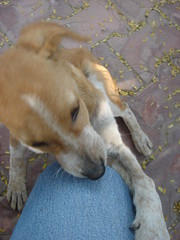
Here is the cute puppy, galu galu (means puppy), who has adopted their family. I'm invited back the next morning, when a club of healers will be meeting for a trip, for more attention. There, I receive healing from their teacher. Your correspondent is reported to be a very sensitive being. The teacher recites some of the ritual in English so I can understand more of it. This is all very interesting to me, and I do feel good afterwards. Some of the practice is comparable to Alexander, but this isn't the place to get into a close analysis, or genealogical speculations. No showering is permitting for 12 hours after the treatment.

da mall

Sulay, Shalin's cousin, and I go to a modern mall. We play games. Owing to our dexterity, wit, speed, and strength, we win prizes.

prizes!

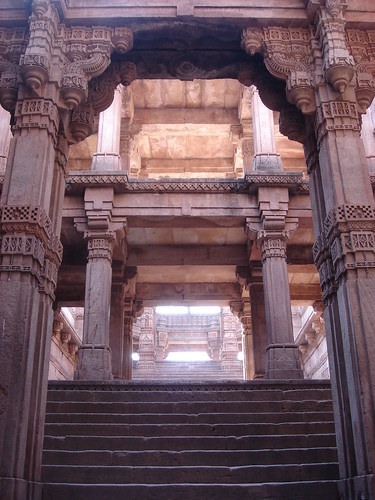
Parag takes me to Adalaj, a step well that descends multiple flights of stairs into a well. It is 500 years old, and is absolutely beautiful. Intricate carvings are everywhere. Here is a view up the steps, out of the well.


step well, looking up


It is truly amazing. You can imagine lots of travelers resting here, and colorfully dressed women balancing jugs of water going up and down the staircase to fetch water. You don't have to imagine any of that, actually -- you can imagine whatever you want!

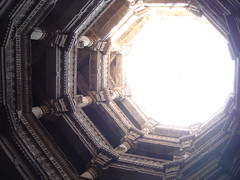
looking up out of the step well

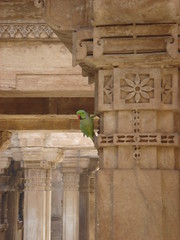
Pretty, si? I am standing at the bottom of the well, looking up the cylindrical shaft into the light. I descend down a circular staircase, probably originally for guards, and find my way to the platform on which I earlier saw parrots.

parrots hanging

I begin to formulate an exit strategy. And just like that, we're off, to Hampi, in search of adventure, sport, and fitness. Stay tuned!

Textiles Anonymous

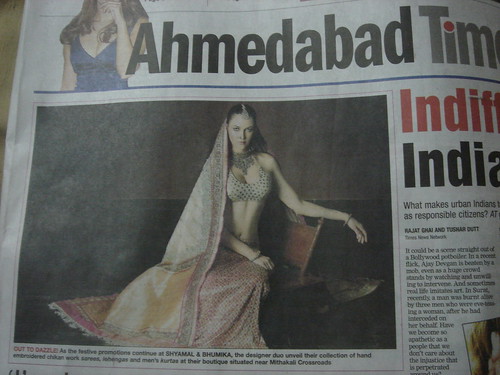
Shalin's older brother, Shyamal co-operates a fashion design house with Bhumika, his wife. Together, they operate Shyamal & Bhumika. Below, is one of many articles about their work.

coverage

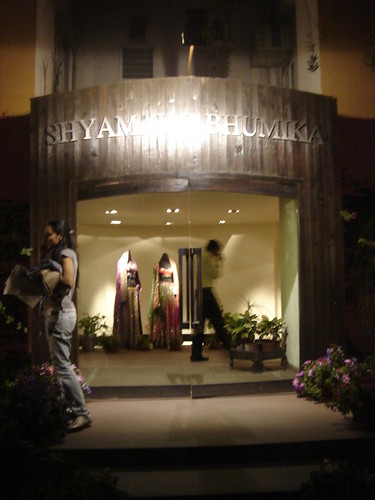
Here is their storefront. It's really beautiful. Their entire store would fit perfectly into any fancy street in LA, New York, or Tokyo.

Shyamal & Bhumika

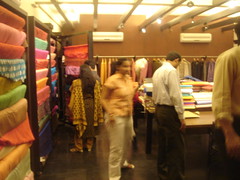
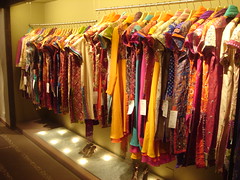
The inside, and the clothing, are all blindingly colorful and lovely.

downstairs

But where do all these clothes, materials, and designs come from? I can share a small amount of information, not because of any particular non-disclosure agreements that may or may not have been signed, but because I know very little.

pick me!

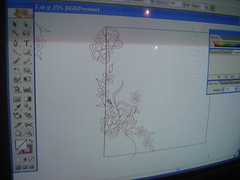
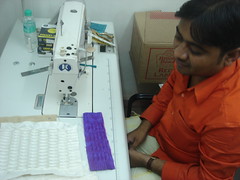
Pictured below is Ishani (Shalin's cousin), a professional textile designer working for the aforementioned concern. She is designing a pattern in illustrator that will be embroidered onto a fabric.

sulay

She must consider not only the repeating composition, but also how it will be stitched as a continuous thread. Of course, it has to look nice, too. Embroidery, for those of you filling those shoes I, until only recently, occupied, means that thread is sewn into an existing fabric, creating a design. Those who are not squeamish about prematurely revealed endings, may scroll down to a hand embroidered detail below.

textile design in illustrator

I never realized that nowadays, someone sits down and designs these patterns. I thought there were simply standard patterns that are copied and pasted. Not at all, it turns out. India has a long history of textile design & production. Ishani looked at lots of reference material before undertaking the above pattern. Some are created from her imagination, such as this bed sheet design (below).

a bed-set design

She says that India has a huge library of traditional designs and art to draw from. By way of example, here is a curtain from Shalin's house.

curtain

The designer/philospher Christopher Alexander comes to mind, who claims that good designs reuse historically, organically, evolved patterns. The fifteen properties Alexander argues are fundamental to the universe and good design, such as strong centers, symmetry, and boundaries, are all obviously at play here, as well as the traditional Indian visual design language.

shyamal

Here are our eponymous heroes, hard at work.

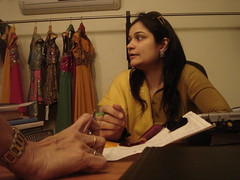
bhumika

Bhumika is discussing design, and directing her staff. Actually, I have no idea what she's doing, because the conversation is not in English. But, familiar with game production & design, a similarly industrialized creative process, I immediately understood what was going on. Designs were discussed, samples reviewed, feedback given, and direction decided. Bhumika is pregnant, and is still working very hard, despite the fact that the baby is due soon!

prototyping a material

Many of their textiles are hand woven, hand embroidered, designed in house, and assembled in house. From sales to production to design, it's an entirely integrated operation. In a different location is a team of about 70 folks, if memory is correct, building the actual clothes. In house, they have a team of about 5 doing alterations, and prototyping materials and designs. Above, you can see a tailor with a test material he has produced, to be reviewed by the designers. Below, a tailor is assembling some clothing out of a hand-embroidered material.

preparing a hand embroided material

I learned a few more things about the fashion industry. Those catwalks, populated by models, are a critical part of the biz. Right now, this shop is trying to complete a collection that will be displayed in Mumbai, alongside other designers' work. The catwalk is an advertisement for buyers. Buyers will put in orders, and ask for changes -- all in time for seasonal fashion changes.

embroidery

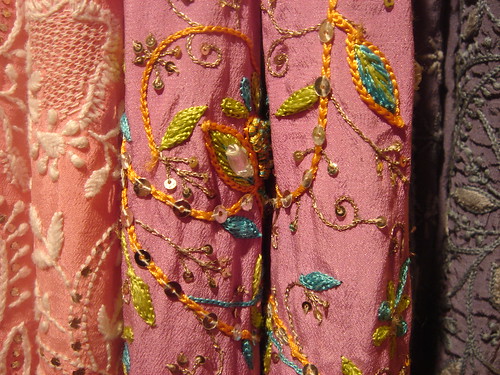
Above, a detail of some hand embroidered clothing. Some of these wedding saris take 5 people 2 months to make, and the one I looked at cost approximately $600 USD. That's about a year of labor, total. 40 Rs (Rupees) is about 1 USD, and a meal in India is about 40 Rs. Their primary clientèle, I understand, are Indians living abroad.

calico museum

Determined to learn more, Sulay (Ishani's brother, and Shalin's cousin) and I undertook an expedition to Ahmedabad's Calico Textile Museum. Tours by prior appointment. Photography not allowed. Words are, naturally, the wrong medium with which to paint for you what I have witnessed, but they must suffice.
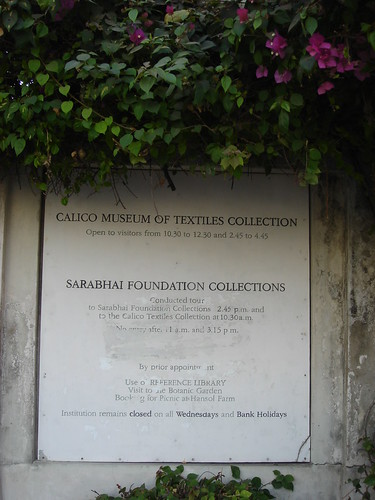
If you find yourself in Ahmedabad, this tour is absolutely worth undertaking. The grounds and architecture of the museum are alone worth the price of admission, which happens to be free. But even if it were not free, the grounds alone would be worth the visit to the museum. I saw parrots, peacocks, and humming birds in the gentle gardens that surround the place.
When I was young, I was always bored by museums like this. Now, using my imagination -- a hard earned Graphics History Visualization Engine (GHVE) -- I find it more enjoyable. If I look at a dull flag, I imagine it bright and colorful, as it once was, leading an army unit of Gujarati warriors, waving in the wind. Kids must be awesome bored here -- you need someone to bring it to life. Our tour guide, and the exhibits, feed my GHVE with enough data to go on. There's so much to see here, we barely touch a fraction of it on the tour, and I describe a fraction of what I've seen below.

We see a long hand painted scroll depicting a historical event. A storyteller, armed with a candle and musical accompaniment, would narrate the events depicted here. Ancient made for TV news drama. Alone, like history, it's just a scroll. With a storyteller, it's magic.

Textiles made in Gujarat were found in the Egyptian pyramids. Apparently, they were exported to royalty in Bali, Japan, and Egypt. Lots of interesting, and time consuming, techniques are used to make these fabrics. Paisley patterns have an Indian origin -- they are the bottom of a clenched fist dipped in paint. Tie-dye was originally, and remains, a technique for patterning a textile by applying minute drops of wax to carve out an elaborate pattern. I saw embroidery so detailed and rich that the detail above looks like a hack job. And some wacky Atari 2600 looking materials made from pre-dyed threads, which are then woven together, producing a pixelated pattern.

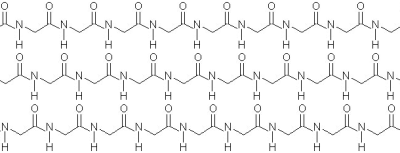
Most interesting to me is the link between how humans make dimensional structures, and how nature does it. We are, when we make origami, or spinning thread from shorter natural fibers, sewing, weaving, casting -- increasing the dimensionality of our materials into more and more sophisticated shapes, forms of higher dimensionality. We have devised elaborate technologies for doing so. Computers, which have simple linear memories, use software to fold this single linear thread of memory into complex data structures, three dimensional graphics, and sophisticated organizational structures. All of computer science is reducible, in some way, to this endeavor, much like organic chemistry, or textile production.


We're not too far off from how the natural world does it. In the case of many organic forms, elements are arranged in arrays, coils (threads), and woven into tissues, which are folded and glued into three dimensional organs. When we humans make clothing, we start from natural plant and animal fibers, leveraging what billions of years have naturally evolved for us. We turn these fibers into longer threads, which we then arrange into two dimensional fabrics, from which we create clothing, tents, bags, paper, and kinds of other beautiful and useful forms.

Monsoon Wedding

While I did miss Ahmedabad's kite festival, I am here for peak wedding season. Indian weddings are epic affairs. One night we went to a party, outside of town on a farmhouse, hosted by the bride's family. These parties seem to go on for multiple days. This was actually the second night of musical performances for this particular wedding. This being wedding season, attending so many functions requires serious matrimonial stamina.

welcome to our farmhouse

At the farmhouse, a famous singer was performing, and we heard some truly amazing music. Apparently, there was disagreement among the audience whether to start dancing, or continue listening.

performance

I don't speak Hindi or Gujarati, but I was made to understand and feel that the music was about the silent, deep, vibrations of space, the grandeur and mystery of 4.54 billion sunrises and sunsets, the soft melody of lullabies known by heart a continent over, sung by a nightingale with a voice as clear and bright as a star, and lovers dedicating their last breaths to one another, accompanied by tablas pumping out the kinetic rhythm of genetic codes, punk rock power chords, big bang Bhangra, Hindi pop, the most breathless parts of Bollywood movies, klezmer rappers rhyming in Hindi, and the smoky smoldering eyes of an Indian princess, and the gentle tumble of her dark wavy hair.

parag, smruti, and chaim

Here I am with my adopted parents at the party. It's very cold, and I am wearing sandals, plus one of Shalin's outfits, a Shyamal & Bhumika piece.

the procession

The next day we partied like rockstars with the groom's family (neighbors), and friends, before meeting the bride's family.

looking dancing queen

Above, some party goers. Below, things explode and go off. Some kids gather money from the ground.

weddomg explosion gather, gather

That is, in fact, money floating through the air.

dancing a colorful plate

Alcohol is not allowed in Gujarat, but dancing is. I'm told the thali of colors is involved in a ritual, though I failed to observe it in action. Above left, hiding inside the Muppet like quantity of red hairs, is your correspondent.

bandmobile onlooker

The band packs on to an impossibly small car for a change in venues (different part of town), where the the bride's party will receive us. A small child looks on, above.

sari nation party

The wedding was so loud, so boisterous, so big an event, that it took on truly global proportions. Representatives from Moscow and Turkey were in attendance. The American delegation was composed of your humble correspondent, plus a few NRIs. Below, a groom's friend encouraging the band to continue playing more, and faster, with the use of paper currency.

play faster, more! chroma power

It is through the efforts of hard working men and women such as these party goers that India is such a colorful place. The individual pictured above right is doing his part to ensure India remains the world's uncontested chromatic superpower.

groommobile

Riding in the car is a privilege reserved for the groom and his sisters. It is, naturally, pulled by white horses. Click on any of these photographs for more images of the celebrations.

reception for a king

Above, but a portion of the reception space, suitable for a Raj. The daughter is literally to be given away, and she and her sister are both crying. The bride will move into her husband's family's house.

ritual

I understand that the during the wedding ceremony, the groom is warned three times that he is about to be married, and has these last few, precious, opportunities to make his escape from the whole ordeal.

bride & groom

Now that I've been to an Indian wedding I'm excited to return for Shalin's. I'm told that all the arrangements are ready to spring into action -- the remaining step is to pick the lady. No pressure, of course, from these quarters.

Thursday, January 17, 2008

Ahmedabad Limited, part 1

Numerous readers have written in wondering what has happened to our expedition's publication. The truth of the matter, is that our staff is not only alive, but has been very busy conducting important research that will, if things go as planned, comprise a special four part issue on Ahmedabad, India. We now return to our narrative where it left off...

Some people wonder what it would be like to live on a spaceship. We are all passengers, according to Bucky Fuller, on the sun-orbiting Spaceship Earth. I have recently relocated from one compartment of the ship to another, from Israel to India, and my coordinates in this sphere have changed, phase shifting my daylight by three hours.

tel-aviv mumbai, all aboard

Lots of Israelis come to India to travel. Gal tells me that he backpacked through India in 1992. Once, an Indian man, most impressed with the number of Israelis he had met, asked him how many Israelis there are. Gal said about 6 million, to which the man replied: "Not in India, I mean how many are there in the whole world?" That's how many Israelis come to India. Most come after completing their army service, and working to save some money. Why do so many come? We'll have to conduct further field research -- it's too early to say. One reason might be that Israel is so small, and the folks who live there aren't warmly welcomed in their neighbors' countries. Na'amah says most Israelis are here to party, which might very well be true. Some of them were really, really, obnoxious on the plane. I've also met some very sweet ones. For the time being, I'm totally clear of the Israeli backpacker route.

Every place on Earth has its own smell. When I arrived in Tel-Aviv, things smelled familiarly Israeli. Like accents, or the smells of individual people, we don't notice these things unless we encounter something really foreign, or somehow manage to pay particularly close attention. Perhaps it's the food, the soil, the material and energy inputs of a place -- who knows. In the Mumbai airport, my nose felt like I was in India again.

I have an eight hour layover in Mumbai. Unfortunately, I'm awesomely tired, jet-lagged, and slightly sick, so I spend about five hours curled up in a cafe upstairs, eating, drinking, sleeping, and napping. There are worse fates, I suppose. The irony, of course, is that my cold came on in Israel, but I've gotten better in India. Last time I was in India with Yotam and Naomi, we all got sick, and I think one of our problems was that we didn't eat enough. One can never eat enough.


shantytown in mumbai

The airport in Mumbai is surrounded by what appears to me to be a large shantytown. You can see in some of the aerial views of Mumbai this very organic structure creeping between the apartment blocks. It comes right up to the airport wall, where it comes to a hard stop. You can see many small children flying kites. In fact, the trees and houses around the airport, and the green on the Ahmedabad airport, are papered with tiny, colorful, handmade kites. It seems everyone dreams of flying. According to my sources, I just missed a huge kite festival, the biggest in the world, by just a few days.

Mumbai Airport Adjacent Shantytown

Ahmedabad is the capital of the Indian state Gujarat, and was the home of Gandhi. Reliable sources inform me that most Indian people you meet outside of India are Gujarati, who are well known the world over as accomplished traders and business people. Vik's, in Berkeley, is Gujarati, and at the Mumbai airport I met two Gujaratis who live in Mozambique.

Ahmedabad Airport

At the Ahmedabad airport, I was picked up by Dipak, Shyamal & Bhumika's driver, who saved me from two very persistent Indian taxi operators. Shyamal is Shalin's older brother, whom we met in issue #3 of Phases Crossed, and Bhumika is his wife. They are both very sweet, and I had met them both in Berkeley last summer. Together, they own & operate a fashion design shop called Shyamal & Bhumika, which we'll cover in an upcoming fashion and textile technology edition of Phases Crossed.

Ahmedabad traffic

You can see in this traffic photo that things in Ahmedabad can get pretty hectic, not to mention smoggy. According to Bucky, life creates anti-entropy, and wealth self-replicates -- a fundamental law of the universe. Technology and knowledge compound, giving us more with less. So many motorcycles equals so much wealth! And now Tata has a $2500 USD automobile, the world's cheapest car. Bucky didn't account for the problems with the environment we have the world over, though, as we asymptotically approach what some might call a technological singularity. Maybe the singularity is something else...

parag, smruti, and chaim

I've been adopted into Shalin's family -- there's simply no other way to describe it. Above, our intrepid explorer with his new parents, dressed for a wedding (stay tuned for an upcoming special matrimonial edition of Phases Crossed.) My new brother, sister, grand-parents, cousins, and parents are unbelievably sweet and kind. Now I understand why Shalin is so nice. Shalin and I both agree that his grandmother is particularly cute (pictured at left).

cutest grandma smruti

Like any good grandmother, her encouragement to continue eating never stop. Through careful research, I've determined that the probability P, that I am encouraged to eat is a function: P=f(time into meal, rate of eating, food on plate), where y = (1-t) * 1/r * (1-f).

neighborhood street shalin's room


I'm staying in Shalin's room (pictured above, alongside a neighborhood street). He has an old 33600 bps modem on the floor by his (old) computer. Respect. Below are pictures of the house, and the family cook making something delicious.


house cooking

Everyone, his brother & sister-in law (Shyamal & Bhumika), his father's parents, his parents -- all live in a really nice house with some servants. Gujarati food is incredible, and like Southern US cooking, is a bit sweeter. For dinner the first night we had some south Indian food, plus some sweets, and a Western casserole dish. They also have the best Masala Chai I've ever had in my entire life, which is now changed forever.

grandpa lemongrass green tea

Here are some photos of the house and garden. This is a green tea plant. It smells... unbelievable. Shalin's grandfather, the head of the household, says I have a keen sense of smell.

DSC02824

Why? We walked into the garden, and I went on about its keen aroma, and asked him excitedly what in the garden smelled so nice. He laughed and said it was his hair. Well, yup.

Did I mention that they have the best Chai in the world here, in this house? Every time I am offered some, I take it. One morning, I had some for breakfast, and the grandfather (who was once a rockstar cricket player for India), said he had put some of the green tea into the Chai. I observed that it tasted like lemongrass. Ah, it turns out it is lemongrass green tea. Maybe I do have a good nose, after all.

Tuesday, January 15, 2008

Passage To India

A very merry un-un-birthday to Shalin, Mr. Luther, myself and many others who share this birthday. Phases Crossed is back with its longest installment ever, after observing two days of radio silence, for a special birthday edition.

I have trouble with dates, as some of you know, and my birthday kind of snuck up on me. Sometimes it's hard to remember how old I am; usually there's an off by one error. Although fully prepared, another event that surprised me is my flight from the land of milk & honey to the land of chai & chutney. Israel to India, tomorrow, in search of warmer weather, among other things. Dan & Sarah have checked out the Samosas in Goa for us, and assure Yotam & me that they are of the highest quality. I'm arranging to import several thousand of them to Tel-Aviv, where they will be enjoyed in a large festival.

I originally intended to title this blog Passage to India, but that turned out to be someone else's travel blog about backpacking India. So, in the way that those who search for unique domain names search, I tried every variation of the title, only to find that each one had already been though of, and populated with chronicles of sub-continental adventure. So it goes. But what, you ask, does Phases Crossed refer to? As should be clear to anyone with the world's information at their fingertips (a.k.a. Google), it is a communications term, but our exact namesake will remain a mystery for now.

I love Walt Whitman's poem Passage to India, and believe it is an absolute pre-requisite for the readers of this blog. Otherwise you might drown in what is sure to become endless and senseless sea of literary references, similes, and circumlocutions.

At no extra charge, here's a free sample from the second verse:
Passage to India!
Lo, soul, seest thou not God's purpose from the first?
The earth to be spann'd, connected by network,
The races, neighbors, to marry and be given in marriage,
The oceans to be cross'd, the distant brought near,
The lands to be welded together.

A worship new I sing,
You captains, voyagers, explorers, yours,
You engineers, you architects, machinists, yours,
You, not for trade or transportation only,
But in God's name, and for thy sake O soul.


full poem...

But we're getting ahead of ourselves... We haven't left Israel yet, and our embedded correspondents still have much to report. First, some narrative is required to connect our readers with our adventurers' present locations. Our fellowship has been officially, and tearfully, disbanded. Nadav & Anya have returned to The States (which is how we refer to the US here, at least in my incomplete understanding of Hebrew), and Aaron has returned to Belgium. A note to future generations: don't attempt to pick up a rental car in Tel-Aviv during rush hour on the eve of Shabbat 30 minutes before the office closes. This is made doubly bad if you are rushing to the wrong address. Noted, and we are so much wiser. The next day, Nadav drops Aaron and me off at 5am in the airport, where I get a another rental, and drive to Haifa to stay with my aunt Rina.

In order to recover from this exhausting ordeal, and the exciting traveling that preceded it, Rina (my aunt) and I spend the next two days eating, napping, and feeding stray & adopted neighborhood cats. Actually she feeds them, I just terrorize them, as my very image is enough to strike mortal terror into the heart of any stray Israeli feline. One of my superpowers, it turns out, and very handy when trying to clear the house of cats for an outing.

living room

This is part of the living room. My father built much of this house with his own hands, so he tells me. Note the orange tree that can be reached by sliding the window open. Best orange I've ever had in my entire life was eaten this week, in this house, from one of these trees. All other oranges are merely shadows of the pure platonic ideal orange that I consumed.

Before we left the house for lunch, Rina and I cleared the house of cats. I surprised one cat on this couch, and he attempted, in his panic to flee me, to leap through the closed window pictured above, and persisted, like a bird trying to fly through glass, to leap three or four feet in the air, his paws scrambling all over the glass, to get outside. He mewed and jumped and jumped and mewed, and I backed off, giving him enough room to make an escape out of the room. It's a strange superpower to have, this effect on these cats, and I will make it my lifelong goal to use it for good and not evil.

rina & cats rina & chaim

Here is Rina feeding some cats, and the two of us on a beach in Haifa, during a rare outing. Paparazzi are everywhere, and it is most unusual that someone caught us unawares in this act.

After spending a couple days with Rina, I head back to Jerusalem to see some family I missed earlier in my busy travels. Israel is a small country, and bouncing between Tel-Aviv, Haifa, and Jerusalem is a matter of hours. I meet my effervescent great-aunt Dina, who takes me to Yad Vashem, the Israeli Holocaust memorial on Mt. Herzl.

yad va shem's jerusalem sunset

This is a really beautiful memorial/museum, and it was redone in the last few years, so while I had been here before, I had not seen the new museum. The museum stresses not just the magnitude of death that occurred, but also the life that was wiped out, in a way that stresses the unique lives of the individuals who perished and endured it. Video testimonials by survivors, art & poetry by victims, and artifacts from pre-WWII Jewish life in Europe create a very unique experience. We spent two and a half hours there, only to be kicked out because they were closing.

The architecture of the building is also very interesting. The entire museum is structured as a long triangular tunnel that slowly rises onto the space pictured above. The entire time, you are moving towards the light, only to have your path blocked repeatedly by ruptures that send you zigzagging through the exhibits that chronicle the journey of European Jewry through WWII. At the start is an incredible video montage made from photographs and video images of pre-WWII European Jewish life, so you begin to feel, in a macro sort of way, the immensity of what was lost. The Nazis, after all, basically succeeded in destroying Jewish life in Europe.

One room, where the Warsaw Ghetto is discussed, has train tracks and bricks from the original ghetto in the floor, lampposts overhead, and speakers playing these uncomfortable sounds of crowds and noise overhead. Without quite realizing how you are being worked upon, or what this space represents, you find yourself hurrying into and out of this main space into side rooms, where you get the intimate, painful, details of what was happening there. Architecturally, what the space is doing to you, is making you feel very uneasy in the main space, so you rush from room to room, which makes you feel weak and vulnerable. Another example of their exhibit design is a spot where survivors tell, through video, of surviving a mass murder in a big pit, where people were lined up, shot, and pushed in. The video screens face upward, forcing you to come really close to the screens to see the people telling their story. As you come close, you see this big concrete hole behind the screens, so you are forced to stand next to this dark pit in order to hear its story.

On with life. Dina and I head over to her brother's apartment in Jerusalem (my great-uncle), where we spend some time with some of his kids & grandkids. Here are the twins Ron & Ora, the aforementioned grandkids.

twins ron & ora

Too bad humans aren't eligible for Cute Overload. (How can it be that a mouse overstimulates the triggers we have for baby cuteness more than an actual baby?)

Afterwards, Dina takes Imri, her son, and me out for Turkish food in honor of my birthday. Next to us, though not present at the meal in physical form, is my grand-grand-father, Dina's father, who made aliyah to Israel with his 2nd family (Dina's).

chaim, imri, and dina grand-grand father

I crash at Devora's, and continue to Tel-Aviv the next day, to meet Itzik. Afterwards, I go for a walk along the beach. Tel-Aviv is a really hip city. Nadav says Tel-Aviv : Los Angeles :: Haifa : San Francisco, but I'm not entirely sure I agree. Some streets of Tel-Aviv feel like the best of both San Francisco's cute shops and architecture, plus the urban-rural neighborhood quality Berkeley can have. In any case, I walk along the sunny beach, wearing a hat and coat (it's cold!), and watch the seagulls, sand, and water. It felt especially good because the cafe was playing this album of languid, trip-hop-like, jazzy, cover of all of my favorite Pink Floyd songs.

beach & notebook

Boy, it sure is nice to just write without worrying about style, due dates, topics, coherency, grammar, spelling, facts, proof-reading, prior work, excess flowery language, or anything, really. And why not? As long as we don't do permanent harm to anyone's personae, future career, friendships, or marriage, it's all good.

Sunday, January 13, 2008

25 Horses

We decide to visit Jerusalem the same day Mr. Bush does; we suspect a leak somewhere in our party. Apparently, this is a terrible idea, as the entire city has had its bus lines rearranged, streets closed, buildings moved, and the like. So, we bus in instead of driving. This turns out to not be such a stupid idea, as the city is pretty quiet -- nobody goes out for fear of getting stuck in traffic, and we have no problem getting around. Here is Anya and Nadav on the bus.

traveling at the speed of together

Speaking of horses, Nadav throws out a problem from the Microsoft/Google computational interview canon. More interesting than the problem, perhaps, is the ensuing joke: A physicist, lawyer, designer, and mathematician get on a bus to Jerusalem and discuss a math riddle. No rabbis or priests here. Luckily, we're all still friends. We discuss the following problem: You have 25 horses, and each runs at a constant speed, but each horse can have a unique speed. So, these horses never get tired or anything. You can't know the absolute speed of the horses, but you can race up to 5 horses at a time, and learn their relative speeds. So, given 25 of these horses, what's the minimum number of races you need in order to find the 5 fastest horses, ranked in order of speed? Email me if you think you have the answer.

Our cast today is the regulars, Nadav, Anya, Aaron, and Chaim. Later in the program we'll have a cameo appearance by Devora and David, who we've already met, plus Michelle, whom we haven't. Various strangers will wander into and out of our photographs as well, but we can't be expected to know them all by name.

On our way to meet David for a tour of the Western Wall Tunnels, we walk by Ben-Yehuda Street, and find a larger than normal number of soldiers guarding. Some of them are braiding each other's hair (look closely at the below picture). I ask permission to snap a photo, and they agree and smile, commenting that I am chamud (cute). Well, we all are, I guess.

israeli army gals

The western wall tunnel tour is really really cool. As with most larger than life phenomena, the model (below) is often cooler than the real thing, which is too big to comprehend. The model is huge and mechanically transforms to reveal various moments in time. It's truly cool.

tunnel model

Before I explain what we're looking at, some background is in order. The twisty roads and traffic of Jerusalem, the fighting, the political stuff -- it's all a surface manifestation of these intersecting stories and impacted architecture that spans the course of thousands of years.

western wall tunnel

I have this profoundly obvious realization as we exit into the Muslim quarter, and find ourselves in front of an ancient, bone white, church. Of course, someone else's tour stops at this church, and it's a really important point on their journey, but for us, it's just one of a thousand patches on a quilt that compose our Jerusalem's background, and we think nothing of them. They are simply color, texture, and space. These patches, however, are tiny sidelong glimpses into other worlds, and other people's stories.

tunnel tour exit

People have been building on top of, inside of, and between one another here for thousands of years. The tunnel tour takes us underneath the Muslim quarter, and travels an extensive buried length of the Western Wall, letting us see just how huge and expansive the temple mount was. It also comes as close as possible to the ancient Jewish Temple's most holy location on the temple mount, which is, naturally, underneath an important Muslim site. Silly of the Jews to build something so important underneath someone else's really important something.

golden dome

Next, we go to this wacky interpretive art Jewish history experience thing. The glass sculpture below is part of it. It's a veritable aural womb we enter, very high tech, full of interesting glass art, DMX lighting, and lots of narration by the guy who must do all the movie trailers. By the end, we understand why he just does trailers, and not full length film narration, and have a similar feeling about the entire installation. It's like a really good soup made into a 12 course meal.

sci fi art history

We complete our party by meeting Michelle and Devora. We now have a sizable Berkeley-Jerusalem contingent, and we raid several respectable locations, such as a cafe, restaurant, and bar.

get-a-long jerusalem gang

The next morning, Nadav, Aaron, and I go to Nadav's favorite Tel-Aviv breakfast place. We meet a crazy man waving a glass of coke from a neighboring restaurant, who demands we bring him ice from the one we're waiting in a queue for. He goes ballistic when we explain that we won't do that. Luckily, I don't understand enough Hebrew to comprehend the depth of his anger and insanity.

hungry hungry nadav

I believe that this is some kind of hybrid French-Israeli place, and it totally kills La Note in Berkeley. We can't locate the impressionistic landscapes on the wall anywhere in Israel. Plus it has that certain jen a se qua. The food and place is still totally Israeli. This meal changes our lives a little bit for the better, and we get philosophical.

fresh food

First, Nadav's theory on Israeli fruits and vegetables. People eat a lot of them here, and they are so fresh and good, it's hard to explain. Nadav thinks that this is due to the size of Israel -- it's so tiny, that all produce is basically local and super fresh. The worst case food transportation scenario is probably the best case in a typical American city. If America had such good tomatoes, cucumbers, and more, people might actually like to eat them.

My entire life my father, who grew up in Israel, called sour cream shamenet. He loves it. The white dollop on our plates is in fact this magical substance, seasoned with Za'atar. It doesn't taste like sour cream, since it's not bitter, but it's the closest approximation one can get in America. Shamenet tastes like true love, and it literally translates to something like "fatty". The cottage cheese available here, also, is just one of many life changing dairy products available for purchase in any holy land corner store. After eating the real shamenet, I feel like I understand my father more.

This brings us to our last food related point. The portions here are insane. If you thought American was bad, corporate America putting piles of corn derived products in front of us to maximize their revenue, owing to minimal marginal costs, Israel will blow your mind. Nadav calls Israeli food portions the post-Holocaust sized meal. Nadav thinks it's this multi-generational neurosis that creates these meals. Throw in some Jewish parents, and you have culinary absurdity. We order two meals for the three of us, and can't finish it. And we were terribly hungry. The time before, we order one meal for the three of us, and it's about right.

Oh yes, careful readers have found numerous factual errors relating to dates, locations, and even, at times, identities. As a consequence, our entire fact checking department has been let go. We apologize for the inconvenience. As for the future, we make no guarantees as to the correctness of any information contained in this blog.

Friday, January 11, 2008

Northwest Passage

Salaam and good evening, morning, or X, where X = time of day at your geographic locale! In our marvel filled world of fast chattering devices, one can never be certain.

b'hai gardens

This issue of Phases Crossed takes us to northern Israel. Our trip begins in Haifa, where we'll return in a week for more activities. Here is a photograph of the B'hai gardens in Haifa. Nice, no?

A word on pacing. This trip, so far, has been action packed rapid fire never a dull moment for anybody anyhow anywhere. It's not about the email, though. It's about Aaron. This trip is a go-get-em compressed top hits of the past three thousand years Israel tour, and soon that comes to an end, as we leave the comfort of Nadav's parents' Tel-Aviv apartment (Thanks Ora & Yoram! xoxo!), Anya and Nadav return to the states, and Aaron, who has never seen any of Israel, heads back to Belgium to continue his groundbreaking legal research on the Belgian deep frying system, and its effect on North American culinary attitudes, and tort reform.

What I'm trying to say here, but having trouble, is that this trip will soon slow down to a more leisurely, less type A sort of experience soon. Which is good news for the company of writers who are editing, writing, and formulating the text of this publication. They're about to go on strike.

company of bandits

Here we are posing for an Ars Electronique publicity photo for the fall 2008 SEC filing, travel swimsuit edition. This is the Tiberias bus depot, a necessary logistical stop on our tour north. As the guidebooks might say: fans of rustic linens, and students of the algebra of desire look no further -- this city has it all, just bring your own soap and a desire for adventure. Feels like Nevada to me. Devora, our travel buddy and incorrigable tour guide, buses in from Jerusalem and meets Aaron, Nadav, and myself in the city, where we have spent the night in anticipation of a full day of travel into barren contested territories and more.

kinneret graveyard

This is a really interesting graveyard on the shore of the Kinneret, or The Sea of Galilee, where 1/3 of Israel's water comes from. The lake is an important place, and it sits under the Golan heights, which we'll get to later. This area is the site of some of Israel's first Kibbutzes. This graveyard is where many early settlers to Israel from Russia and Eastern Europe are buried. They came early in the 20th century, most of them very young and idealistic.

There were all kinds of problems and wackiness like Malaria we won't get into. Naomi Shemer, who wrote Jerusalem of Gold, is buried here, along with lots of other interesting people and interesting stories. One interesting story Devora told us, is that there was a small splinter group of devil worshippers here that were booted out of the main camp of Zionists, who found them a bit too weird for their taste. Recently, a really unusual buried grave was found, from the early 20th century, and it looks really really devilish and punk rock. Creepy. Apparently, the guy was one of these outcasts, and killed himself (which is not Kosher, but the graveyard technically isn't). One historian thinks he was sacrificed to the devil. You can see and read more here. Creep-tastic.

shallow kinneret

This is the Kinneret, which has a dangerously low water level right now. Lots of shells abound, but most Jews don't go for that kind of fish.

over water

Next, we drive up into the Golan (below), which Israel captured from Syria in 1967. It's hard to describe how high this high ground is. It just goes straight up from the eastern shore of the Kinneret, and over into Syria. It's cold, and we see very little human stuff, except a few farms, some military installations, and an abandoned Mosque.

ha golan

We go up to what is probably one of the highest points, to an old military bunker overlooking Syria. There's a delightfully named coffee shop here, and not much else. In Hebrew Annan is cloud, so the name of the shop, on the one hand, is "Cloud Coffee," which is apt. It's also a reference to Kofi Annan, a former secretary general of the UN.

coffee annan

Bunkers are cool, and you can kind of get a sense of how high up we are, and the stuff below is actually quite high as well.

golan bunker

I was the last one to leave, I think, and I had to emphasize that this stuff (military fortifications) is really cool for boys. Click through for more pictures.

bunker babes

Here is our entire expedition team at this point:

golan adventure team zero

No bunker would be complete with a maze of tunnels and rooms below ground. Fa. Above ground trenches are so world war one. Dahling, you wouldn't want to be caught dead in one.

underground bunker

We discuss the history of the 1967 war in a museum inside the bunker, and Devora makes the point that one doesn't really win a war. It's people dying and territory moving around from a country to the next, but to speak of winning and losing is actually a bit weird. Strip away the national aspects, and it's just disaster accounting.

Leaving the Golan Heights, we go to an excellent restaurant called Dag on the Dan, and meet this guy. Fowl of all kind abound.

peacocking

We go to the old Jewish mystical city Tsfat, and walk around. We find a Cafe Baghdad. There's also one in San Francisco.

cafe baghdad

Nadav and I bet one another 10 dollars that we will go to Baghdad in our lifetime. I forget who bets which way. So concludes our tour. This was, in fact, one of the longest days of the trip, and we even go to bed after 10pm, incredibly. Night night.

Wednesday, January 9, 2008

Negev my Negev

DSC02513

Yo, what's up? For this leg of our trip we be taken it south, to the Negev desert, where we be sporting sunglasses and funny hats. The word Negev could use verbification in my opinion. Where is Negevize, Negevate, for example? The Negev is where it's at, the hotness, the coldness, the dryness. There be dead seas, mountains, craters that aren't craters, and food that make you the happiest eaters alive. We hope you enjoy. The actors this time around are Nadav, Aaron, Chaim, and our ever-energetic tour guide Devora. Notably absent is Anya, who is spending time in Russian with her relatives.

Jachnun delivery

All travelers need food, and in our case we need Jachnun. We stop at a family restaurant in a small village off the highway for this traditional Yemenite dish. Shunning the more modern Israeli cafe food, we follow a series of hand written signs for many kilometers, and eat the most delicious meal ever prepared for any king, ceo, or traveler. It is, as I make sure everyone understands, the happiest day of my life.

Israeli Yeminite food

This is the cutest restaurant in the world. Click through for more pictures of what it looks like, and the happy eaters contained.

overlooking the maktesh

We go next to Mitzpe Ramon, where we crash at Nadav's aunt's house. Here are our intrepid explorers daring the mild desert climate for a photograph at an important geological site. A site of geopolitical geological importance. That's right, here we are at the Ramon Crater. As should be obvious to any skilled observer of tourist photographs, it's not a crater at all, it's a maktesh, or an erosion cirque. The thing is so big you wouldn't even know you were in it, since it just kind of goes off the horizon in multiple directions.

desert swing set

There's all this cool desert art sculpture near Mitzpe. It's like burning man, but without the burning, the man, or the people. Just the desert and the art. Aaron and Nadav are pictured here doing their part in the fight against gravity.

ben gurion & nadav

Not far away is Ben-Gurion's grave, the first prime minister of Israel. The architecture is interesting, and it overlooks a magnificent desert vista. It feels like you are being swept by a stream down into this location, and everything is the height of a man, making you feel neither small or large. Ben-Gurion has some interesting history with the Negev you can read about if you follow the link.

DSC02525

We drive from Mitzpe to the Dead Sea. I share the driving. Incredible how quickly my inner Israeli driver shows himself. We drop off Devora for a job interview, and say goodbye to her for now.

En Gedi Field School

Our room in the field school in En Gedi.

wakey wakey

An important part of any Israel trip is hiking up Masada, where a bunch of Israelites killed themselves around 66 BC. They called themselves Zealots, and defended a desert fortress built on a mountain top from the Romans for a siege which lasted many months. It is from them that we get the words zealot and zeal. Zeal is truly a terrific word!

DSC02552

I run into a few of these animals on the way up. One of them, with big horns, waits in my path. Thinking back to a monkey troop Yotam and I once encountered in Malaysia, I decide it's best to not get in its way. I wait a while, then make some noise, he runs off, and nobody is gored. Pictured above is one of the fairer sex.

DSC02559

The American team, represented by Nadav, Aaron, and Chaim (above) reaches the top of Masada first, before sunrise. A formative experience in Chaim's earlier years creates a deep need to get up at 4am and be the first to the top on this day. A team of Russian climbers poses a slight challenge, but is easily overcome when they take a wrong turn.

DSC02572

Here is the world's earliest known photograph. It was uncovered in the Dead Sea Negatives, and is reproduced here for all the world to see. In it, you can clearly see a Roman siege tower which was rolled up an earthen ramp (up the side of a tall mountain), attacking the fortress. The next day, the Romans knock, but nobody answers. Everyone here is dead via a complicated form of suicide, except a few people who tell the story. Two women of above average intelligence, according to Josephus Flavius, and some children.

Masada Gear

Yours truly in the hot bath room. I can never say no to a sauna. A set of baths up here? Yes, the fortress is huge, and my small camera can barely suggest how massive this mountain is. There are multiple palaces up here, baths, a large set of water cisterns. Next door is the frigidarium, but this picture was taken in the hotatorium.

Driving by the dead sea

We go next to En Gedi, an oasis in the middle of this desert. It's hard to believe that all you can see in every direction is totally and completely dry, and yet you have these waterfalls and lush growth. Complete with animatronic looking mammals. We figure they just move slow, since they are more like lizards in habitat.

DSC02593

We don some sun screen in the parking lot, much to the delight of some college age tourists, and show some skin. The water is cold, and it's not a particularly hot day. But, this is a fashion magazine, after all, and we can't bare to disappoint our readers.

kung fu climbing

I climb over for a photo op with the waterfall, but the climbing photos are totally cooler than the product.

Hot & Salty

Here are the desert gentlemen, in a hot & salty picture, by request, at the world famous Dead Sea. The Dead Sea is very salty, and actually has bacteria living in it, so it isn't totally dead. It's so salty you float with no effort. You can stand in the water and just bob there. On your back. On your front. In a box. With a fish, on a dish, with a mouse. It's fun you see, you should try it sometime, and be like us & me!

Monday, January 7, 2008

Ah Jerusalem!

International travel does strange things to time, and jet lag is just one type of time distortion possible. There is also the experience-photograph-upload-blog time delay phenomena. For example, yesterday Nadav, Aaron, and I woke at 4am to hike up Masada, an ancient desert fortress, to watch the sunrise. But today I will write about the events of Jan 3. An upcoming edition will chronicle everything between then and that.

so cute

Careful readers will remember I landed in Tel Aviv on Jan 3 at 3am. Anya and Nadav, pictured above in all their awesome cuteness, picked me up at the airport. Earlier that day they picked up Aaron, and they had only arrived a day earlier. We returned home to sleep for a few hours, to comfort our circadian rhythms, since they were all rattling from stress and confusion, and we had a long day ahead of us.

First order of business was an awesome Israeli breakfast, not pictured above or below. Cucumbers here are a force to be reckoned with. Their crispness knows no bounds, and I now understand what it is that Nadav is always trying to approximate back in the bay area. Brokers and farmers take note: Nadav is willing to trade various parts of his body for such cucumbers in the united states.

devora rapping about walls & such

Today was Devora's tour of Jerusalem. First, we had to find Devora's place, which turned out to be quite hard. Anya, Nadav's co-pilot and navigator, despite numerous hardships, managed to get us there. It took a while, and that night she literally had nightmares about navigating Jerusalem, and rebuilding the city on a grid.

Jerusalem, you see, just like San Francisco, is built on this absurdly hilly terrain. SF is a grid, making it pretty navigable, but the roads often take these crazy slopes, like Lombard. In Jerusalem the roads follow the contours of the topography, making them vertically less comical, but navigationally absurd. It's like a city planner sat down with a spirograph, a french curve, and a six pack. Throw in some construction and traffic, and you have all the makings of a blockbuster traffic thriller. Voila!

we think about walls

Devora, true to form, had a scholarly and entertaining tour for us on the theme of wall building in Jerusalem. Pictured above and below is the simple barrier that blocks some gunfire angles from an Arab part of town into Gilo, which is a Jewish development across the 1948 cease fire lines. During the last Intifada, there was gunfire directed at the houses here, and the government dropped these blocks into place to protect the residents.

gilo's wall

It's interesting that to make it less ugly, the people who live in Gilo painted a mural of what is on the other side. The picture, of course, is not as pretty as what was originally there, but it was a lot friendlier too, I suppose.

building the separation barrier

Devora then pointed out that the ancient walls of Jerusalem were also built as a security measure, just like the separation barrier pictured above that intends (and seems to) block suicide bombers from entering Israel from the West Bank. So, walls and security is an old obsession. I think that membranes, walls, and dividers of all kinds is fundamental to the shape of the universe and all living things. This wall is not nearly as gentle to the landscape as the ancient walls of Jerusalem, or even the simple blocks that protected Gilo. It's pretty ugly, but seems to get the job done.

jerusalem market

Here is an open air market in Jerusalem. Well, I thought the Berkeley Bowl was the best grocery store in the world, with the Lonely Planet backing me up, but there's simply no contest.

mm

Here are some delicious borekas, food of champions. Devora took us, along with David (pictured below), to an awesome Iraqi Jewish restaurant in the market. There wasn't much veggie fare, but it was awesome. Who would have thought that matza ball soup, for example, could be improved upon? Put meat inside, and you have Jewish dumplings.

walking the new old city

This is the first Jewish settlement outside of the old city. Nobody lived outside the old city until the last hundred some years, it turns out, and the Jews were particularly reluctant to leave the familiar, comfortable, and secure enclave inside. Old habits die hard.

new old city

Next, we said goodbye to Devora and David, and headed towards the old city. Behind Anya you can see the walls that enclose old Jerusalem.

anya outside the old city

We walked through an Arab market towards the Western Wall, but got lost. A nice Arab kid pointed out where we had gone wrong.

DSC02422

I can't help it, here's another picture of Nadav and Anya:

Nadav & Anya

Here is the Western Wall, and, new for us, some new Israeli Army pledges doing some kind of institutional ritual. The Wall is the last remaining wall of a large support structure, on top of which was the ancient Jewish Temple that figures centrally in all kinds of Jewish belief and ritual. That Temple was last destroyed by the Romans. Now, on top of the Temple Mount, is a very old Mosque that is is very important to Muslims and the Palestinians. Nothing is simple here.

western wall + israeli army pledges

Some Jews come here to pray, and some put little notes on pieces of paper that they slide into the cracks between the stones. The Army pledge thing was new to us. Boys, about 18 years old, seemed to be getting inaugurated into the Army. There wasn't much wind, so the Israeli flag had some kind of rod in it to keep it up. Like Prozac, but for flags.

That's all for now. More pictures and adventures coming soon.

Wednesday, January 2, 2008

Quick Blur


Dusk at the Amsterdam canals
Originally uploaded by markopoulos
I've just endured a crazy three day blur of travel. I finally got some sleep mediated by pillows and the like and a real horizontal surface. I feel rested, clean, and hungry. Not even sure if it was 72 hours, but I did leave San Carlos on the 1st, and arrive in Tel Aviv on the 3rd. Nadav and Anya picked me up from the airport at 3am in some kind of pretty well planned commando-like operation.

In the middle of this trip I remember spending a long time in Amsterdam, going out during the day, and eating a destructive quantity of incredible Indonesian food, plus some awesome fries special (mayo + onions + curry sauce). I am now in a secure Tel Aviv location, that happens to be Nadav's family apartment, and will attempt to stay awake all day while Devora takes us on her awesome Jersusalem tour.